Battery Capacity & Sizing Calculator
Calculate battery storage capacity in Watt-hours (Wh), Kilowatt-hours (kWh), and Amp-hours (Ah). Evaluate usable battery bank capacity across LiFePO4 and Lead-Acid chemistries, or size battery capacity and unit count for your specific electrical load and runtime.
Modern deep-cycle standard with flat discharge voltage. Safely delivers 80% to 90% usable capacity without significant cycle-life degradation.
Single unit nominal voltage (typically 12V, 24V, or 48V).
Manufacturer nameplate capacity rating.
Set to 1 for a standalone battery, or 2+ for a connected bank.
1.02 kWh usable at 85% Depth of Discharge (12V Bank)
If you already own a specific battery bank and want to determine runtime hours across varying household loads, use our dedicated UPS & Battery Backup Run-Time Hours Calculator.
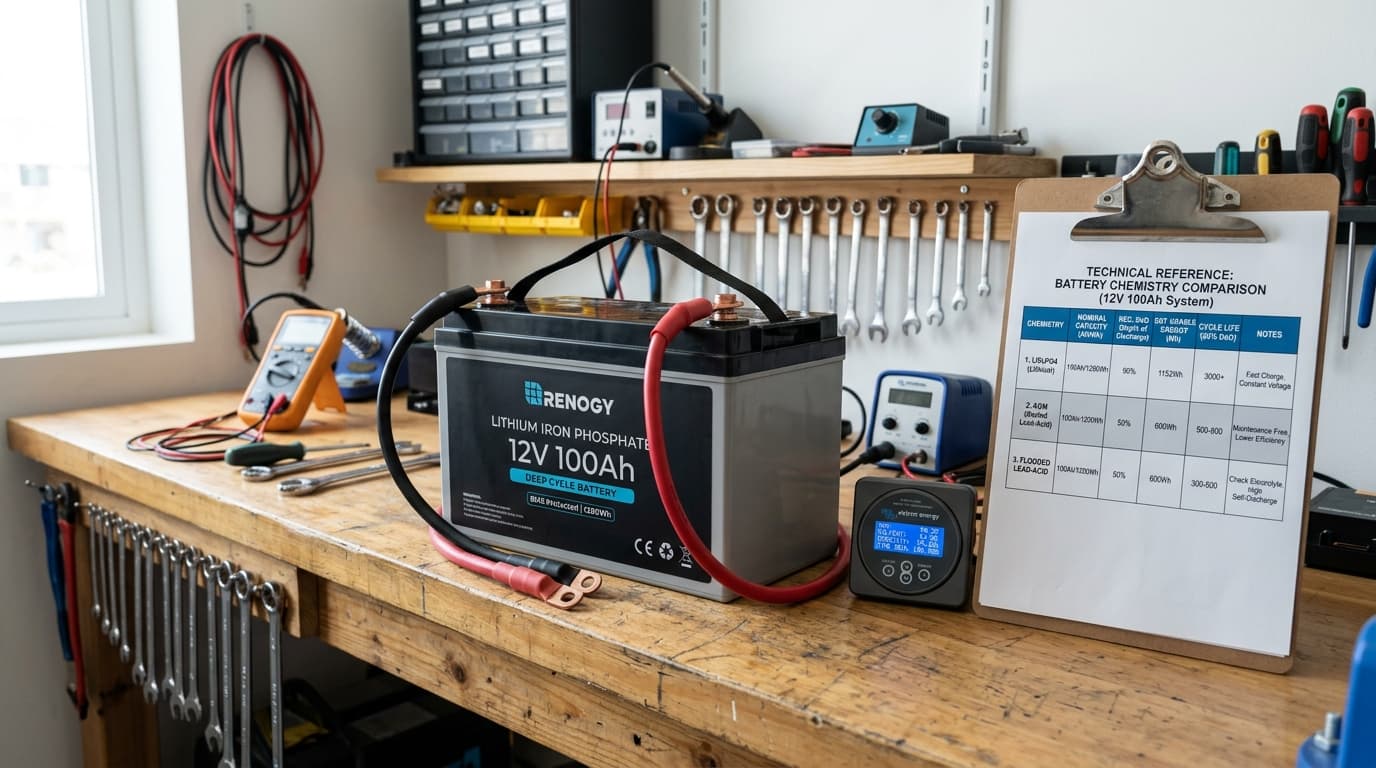
Understanding Nominal vs. Usable Battery Capacity
When evaluating deep-cycle batteries for off-grid solar, RV boondocking, or home emergency backup, the single most common sizing mistake is assuming that 100% of a battery's nameplate capacity can be drawn into appliances. A battery labeled "100 Amp-hours at 12 Volts" stores 1,200 Watt-hours (Wh) of raw chemical energy, but the amount of electrical energy you can extract safely depends on its internal chemistry.
Safely discharges 80% to 90% of rated capacity daily. Delivers 3,000 to 5,000+ full charge-discharge cycles without rapid degradation.
Industry standard guidelines recommend a maximum 50% depth of discharge. Draining lead-acid below 50% accelerates lead sulfate crystallization and destroys plate life.
Used in consumer portable power stations and electronics. High energy density with an optimal operating window of 10% to 90% state of charge.
Because of this chemistry differential, a homeowner replacing a 200Ah lead-acid bank (100Ah usable) only requires approximately 120Ah of LiFePO4 capacity to achieve identical usable energy, while saving roughly 70% in physical battery weight.
Mathematical Formulas & Calculation Methodology
Battery capacity calculations rely on fundamental electrical physics. Below are the deterministic equations used by our engine to calculate energy storage, conversion efficiency, and load sizing.
Variables & Constants
E_nom (Wh / kWh)V_bank (Volts (V))Ah_bank (Amp-hours (Ah))DoD (% (decimal))η_inv (% (decimal))P_load (Watts (W))- Watt-hours (Wh) is calculated by multiplying circuit Voltage (V) by current capacity over time in Amp-hours (Ah).
- To convert milliamp-hours (mAh) to Amp-hours (Ah), divide by 1,000 (e.g. 20,000 mAh = 20 Ah).
- Inverter efficiency (η_inv) must be included when sizing DC battery storage for AC 120V household appliances; direct 12V DC loads bypass this conversion step.
Worked Example: Evaluating a 12V 100Ah Battery
Multiply the nominal 12V rating by the 100Ah capacity. This represents the total electrical energy stored inside the battery cells.
Because deep-cycle lead-acid degrades rapidly when discharged beyond 50%, only 600 Wh is usable. A LiFePO4 battery safely delivers 1,020 Wh, yielding 70% more usable energy from identical 100Ah nominal ratings.
Series wiring multiplies voltage for higher-power inverters, while parallel wiring multiplies Amp-hours. Both configurations produce 4,800 Wh nominal and 4,080 Wh usable energy.
Battery Bank Wiring: Series vs. Parallel Architecture
Multiple batteries can be interconnected to create higher voltage or greater Amp-hour capacity. However, how you wire them radically changes electrical circuit parameters:
| Wiring Type | How to Connect | Bank Voltage | Bank Capacity (Ah) | Total Stored Wh |
|---|---|---|---|---|
| Series | Positive (+) to Negative (-) | Adds Up (V × N) | Unchanged (1 × Ah) | Multiplies (Wh × N) |
| Parallel | Positive (+) to (+), Neg (-) to (-) | Unchanged (1 × V) | Adds Up (Ah × N) | Multiplies (Wh × N) |
| Series-Parallel | Pairs in series, then paralleled | Increases (e.g. 24V) | Increases (e.g. 200Ah) | Multiplies (Wh × N) |
Never connect batteries of differing chemistries, differing voltages, unequal capacities, or differing ages in series or parallel. A degraded or lower-capacity battery will cause premature cell reversal, overcharging, severe balance drift, and thermal runaway risks. Always use identical batteries from the same production batch and verify individual voltages match within 0.05V before connecting them into a bank.
Real-World Variables & Environmental Deratings
Theoretical nameplate capacity ratings are measured under laboratory test conditions (typically 77°F / 25°C at a slow C/20 discharge rate). Real-world installations must account for the following environmental and operational factors:
| Parameter | Model Default | Typical Field Range | Practical Engineering Impact |
|---|---|---|---|
| LiFePO4 Usable Depth of Discharge | 85% | 80% to 90% | Premium lithium cells can be discharged to 90% for occasional outages, but an 80% to 85% limit extends cycle life to 4,000+ full cycles. |
| Lead-Acid Usable Depth of Discharge | 50% | 40% to 50% | Discharging lead-acid batteries beyond 50% causes irreversible plate sulfation and reduces typical cycle life from 500 cycles down to under 200. |
| Inverter DC-to-AC Efficiency | 85% | 80% to 93% | Quality pure sine wave inverters achieve 88% to 92% at optimal load, but light loads and standby idle power lower real-world average efficiency to ~85%. |
| Operating Ambient Temperature | 77°F (25°C) | 32°F to 104°F (0°C to 40°C) | Cold ambient temperatures below 32°F temporarily reduce deliverable lead-acid capacity by 20% to 40% and can trigger BMS low-temp charging lockouts on lithium. |
| Discharge Rate (Peukert Effect) | C/10 to C/20 Rate | C/2 to C/100 | Heavier discharge rates (> C/5) significantly diminish delivered lead-acid capacity. LiFePO4 cells maintain over 95% rated capacity even at 0.5C to 1C rates. |
National Electrical Code (NEC) & Storage Safety Disclaimers
- National Electrical Code (NEC Article 480 / NFPA 70): Stationary battery storage installations must comply with local building and electrical codes, including proper conductor ampacity sizing, overcurrent protection devices (fuses/breakers), and physical disconnects.
- DC Overcurrent Protection: High-capacity battery banks can deliver thousands of short-circuit Amperes. Every battery bank must include a properly rated Class T or ANL fuse mounted as close as practical to the positive terminal.
- Flooded Lead-Acid Hydrogen Outgassing: Unsealed flooded lead-acid batteries emit flammable hydrogen gas during charging and require dedicated exterior mechanical or natural ventilation to prevent explosive atmospheres.
- Lithium BMS Cutoff: Quality LiFePO4 batteries feature an internal Battery Management System (BMS) that disconnects the battery under low-voltage, over-current, or freezing charging conditions. System design must prevent sudden load dropouts on critical circuits.
- Professional Engineering Advice: Calculations provided on CalcMyPower.com are for preliminary planning and educational purposes. Always consult a licensed master electrician or certified solar installer before purchasing or energizing stationary battery banks.
Frequently Asked Questions About Battery Capacity & Sizing
How do you calculate battery capacity in Watt-hours (Wh)?
What is the difference between Amp-hours (Ah) and Watt-hours (Wh)?
Why is usable battery capacity less than nominal capacity?
Does wiring batteries in series or parallel increase battery capacity?
How do you size a battery bank for a home power outage or off-grid solar?
What is Peukert's Law and how does it affect battery runtime?
Related Electrical & Solar Calculators
UPS Battery Backup Run-Time Hours Calculator
Estimate runtime hours and continuous DC current draw for your appliances on a battery backup system.
Watts to Amps Electrical Calculator
Convert real power (Watts) to circuit current (Amps) across DC, 120V/240V single-phase, and 3-phase circuits.
Amps to Watts Electrical Calculator
Convert electrical current in Amperes to Watts and Kilowatts across DC, single-phase, and three-phase circuits.
Generator Size Calculator
Determine what size generator you need for emergency home backup, RV camping, or jobsite tools.