What Does Ah Mean on a Battery? Amp-Hours Explained
Whether you are shopping for a home UPS battery backup, an RV house battery, a marine trolling motor pack, or an off-grid solar storage bank, the letters Ah are stamped across almost every label. Understanding what Amp-hours measure and why nominal Ah math does not guarantee real-world runtime is the key to sizing dependable backup power.
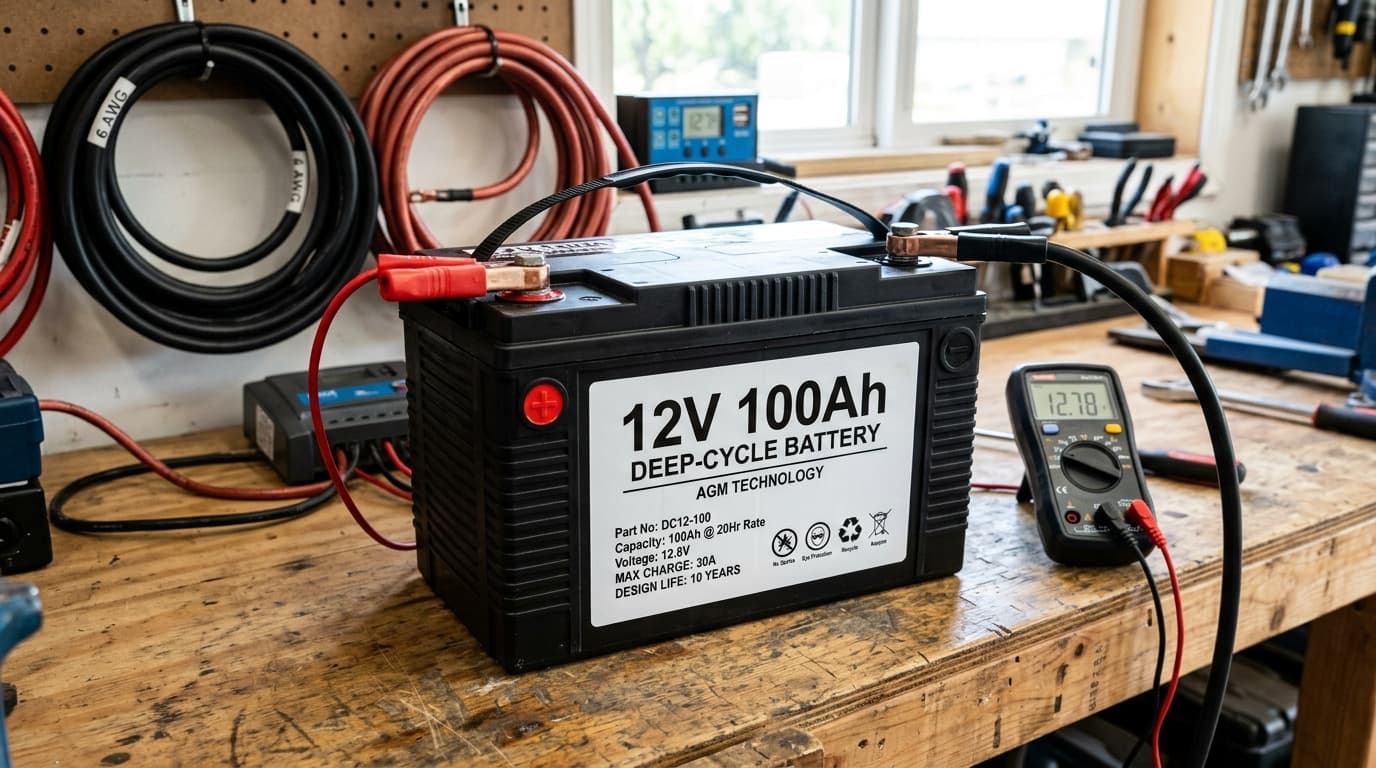
Direct Answer: What Does Ah Mean on a Battery?
Ah stands for Ampere-hour (or Amp-hour). It is a metric of electrical charge capacity that describes how much electric current a battery can deliver over time before reaching its discharged cutoff voltage.
In practical terms, a 100Ah battery can theoretically deliver:
- 5 Amps of continuous current for 20 hours (5A × 20h = 100Ah)
- 10 Amps of continuous current for 10 hours (10A × 10h = 100Ah)
- 20 Amps of continuous current for 5 hours (20A × 5h = 100Ah)
- 100 Amps of continuous current for 1 hour (100A × 1h = 100Ah)
Three Core Facts About Battery Amp-Hours
Amp-hours measure the total volume of electrical charge. To calculate actual work or energy (Watt-hours), you must multiply Ah by the battery operating voltage.
A lead-acid battery only provides roughly 50% safe depth of discharge (50 usable Ah per 100Ah pack), whereas Lithium Iron Phosphate (LiFePO4) safely yields 80% to 90% (80 to 90 usable Ah).
Lead-acid capacity ratings are standardized at a slow 20-hour rate (C/20). Heavy current draws trigger Peukert losses that cut delivered capacity by 20% to 40%.
Electric Charge vs. Electrical Energy: Ah vs. Wh vs. W vs. V
One of the most common sources of confusion in power planning is treating Amp-hours as a direct measurement of energy. Electrical physics defines four interrelated yet distinct measurements:
| Metric | Unit Symbol | Physical Property | Water Pipe Analogy | Governing Formula |
|---|---|---|---|---|
| Voltage | V (Volts) | Electrical potential difference | Water pressure in the pipe | V = P ÷ I |
| Current | A (Amps) | Rate of electron flow | Gallons per minute flowing | I = P ÷ V |
| Charge Capacity | Ah (Amp-hours) | Total electric charge stored | Total gallons passed through meter | Ah = I × t (hours) |
| Power | W (Watts) | Instantaneous rate of work done | Force turning a waterwheel right now | P = V × I |
| Total Energy | Wh (Watt-hours) | Total energy capacity / total work | Total work done by the waterwheel | Wh = Ah × V |
As the table demonstrates, Amp-hours tell you how much current can flow over time, but they say nothing about the pressure (voltage) driving that current. Without knowing the voltage, you cannot determine how much work the battery can actually perform. For a comprehensive walkthrough of electrical energy units and utility billing calculations, read our foundational guide on What Is a Watt-Hour (Wh)? Watts vs. Watt-Hours Explained.
Amp-Hours vs. Amps: Capacity vs. Flow
People often use the terms Amps and Amp-hours interchangeably, but they represent two fundamentally different physical quantities:
Amperes measure instantaneous flow rate. An electric trolling motor drawing 25 Amps is pulling 25 Coulombs of charge per second right at this exact moment. If you switch the motor off, instantaneous Amps drop to zero immediately.
Amp-hours measure cumulative stored volume over time. A 100Ah battery contains a reservoir of 100 Amp-hours. Running that 25-Amp motor consumes 25 Amp-hours every hour, which drains the full reservoir in 4 hours under ideal theoretical conditions.
Just as your vehicle speedometer (miles per hour) measures how fast you are moving while your fuel tank (gallons) dictates how far you can travel, Amps describe your current load demand and Amp-hours describe your battery storage reserve.
Why Voltage Matters: The Hidden Half of the Equation
Comparing two batteries based solely on their Amp-hour rating can lead to catastrophic sizing errors if the batteries operate at different voltages. Consider this comparison:
- •Rechargeable AA Cell: Rated at 2.5Ah (2,500mAh) at 1.2 Volts. Total stored energy: 3 Watt-hours (1.2V × 2.5Ah = 3Wh).
- •12V 100Ah Deep-Cycle Battery: Rated at 100Ah at 12 Volts. Total stored energy: 1,200 Watt-hours (12V × 100Ah = 1,200Wh).
- •48V 100Ah Server Rack Battery: Rated at 100Ah at 48 Volts. Total stored energy: 4,800 Watt-hours (48V × 100Ah = 4,800Wh).
Notice that both the 12V marine battery and the 48V server rack battery share the exact same 100Ah label on their faceplates. However, because the server rack battery operates at four times the electrical potential (48V vs. 12V), it contains four times as much total energy (4,800Wh vs. 1,200Wh).
Rule of thumb: Never compare battery capacity in Amp-hours unless you have first verified that both systems operate at the identical nominal voltage.
How to Convert Amp-Hours to Watt-Hours (Formulas & Math)
Because household appliances, power tools, electronics, and inverters rate their power consumption in Watts (or Watt-hours over time), converting battery Amp-hours to Watt-hours is necessary for any accurate runtime calculation.
Common Nominal Battery Conversion Reference Table
Here is how standard commercial battery capacities translate from Amp-hours to nominal stored energy in Watt-hours and kilowatt-hours (kWh):
| System Voltage | Rated Amp-Hours (Ah) | Nominal Watt-Hours (Wh) | Kilowatt-Hours (kWh) | Typical Application |
|---|---|---|---|---|
| 12V DC | 50 Ah | 600 Wh | 0.60 kWh | Small UPS, kayak trolling motor, portable cooler |
| 12V DC | 100 Ah | 1,200 Wh | 1.20 kWh | Standard RV house battery, marine deep-cycle, desk UPS |
| 12V DC | 200 Ah | 2,400 Wh | 2.40 kWh | Camper van boondocking, off-grid cabin lighting |
| 24V DC | 100 Ah | 2,400 Wh | 2.40 kWh | Medium off-grid solar system, floor scrubbers |
| 48V DC | 100 Ah | 4,800 Wh | 4.80 kWh | Whole-home solar storage, telecom server rack backup |
Practical 12V 100Ah Worked Example: Nominal vs. Delivered Power
Let us examine the single most common battery setup in North America: a 12V 100Ah deep-cycle battery powering household AC electronics through an inverter.
12 Volts × 100 Amp-hours = 1,200 Watt-hours (Wh)
If you connect a 100-Watt appliance (such as an office computer monitor, internet router, and LED desk lamp), simple theoretical division suggests:
1,200 Watt-hours ÷ 100 Watts = 12 Hours of Runtime
In real life, will that battery actually run the 100W load for 12 hours?
No. In the real world, you will never get 12 hours of runtime from a 12V 100Ah battery running a 100W load. Depending on the internal battery chemistry, your delivered runtime will range from roughly 5.1 hours to 9.2 hours. Here is why the numbers diverge.
Why Delivered Battery Runtime Differs from Nameplate Math
When sizing any energy storage system, five physical engineering factors determine how much of that theoretical 1,200Wh capacity you can extract:
Depth of Discharge indicates what percentage of a battery capacity can be safely discharged without damaging the internal cell plates.
- Flooded Lead-Acid & Sealed AGM: Standard safe DoD is 50%. Discharging a lead-acid battery deeper than 50% causes irreversible lead sulfate crystallization (sulfation) on the negative plates, permanently destroying cycle life. That means a 100Ah lead-acid battery provides only 50 usable Amp-hours (600 usable Watt-hours).
- Lithium Iron Phosphate (LiFePO4): Modern lithium deep-cycle batteries can safely sustain 80% to 90% DoD every cycle without rapid degradation. A 100Ah LiFePO4 battery delivers 80 to 90 usable Amp-hours (960 to 1,080 usable Watt-hours).
Discovered by German scientist Wilhelm Peukert in 1897, Peukert's Law states that as the rate of discharge increases, the available capacity of a lead-acid battery decreases non-linearly.
Lead-acid batteries are rated at the 20-hour rate (C/20). A 100Ah battery earns that 100Ah rating only if discharged over 20 hours (a tiny 5-Amp load). If you connect a heavy 50-Amp load (such as a 600W microwave or inverter load), internal electrolyte diffusion cannot keep pace with the chemical reaction, and internal resistance rises. At that discharge rate, a 100Ah lead-acid battery may deliver only 60 to 70 total Amp-hours before its voltage collapses.
Lithium Advantage: LiFePO4 cells have a Peukert exponent of roughly 1.02 to 1.05 (nearly ideal), meaning they deliver virtually their entire rated capacity whether discharged slowly over 20 hours or rapidly over 1 hour.
Batteries store direct current (DC). To run standard 120-volt household AC loads, you must route battery power through an inverter. High-quality pure sine wave inverters operate at 85% to 92% efficiency. The remaining 8% to 15% is converted into thermal heat by internal transformers, MOSFET switching circuits, and cooling fans.
Example: Powering a 100W load at 85% inverter efficiency draws: 100W ÷ 0.85 = 117.6W from the battery.
Battery capacity is universally rated at 77°F (25°C). As temperature drops, chemical kinetics inside the electrolyte slow down significantly:
- At 32°F (0°C), a lead-acid battery loses roughly 20% to 25% of its rated capacity.
- At -4°F (-20°C), lead-acid capacity can drop by 50% or more.
- Lithium Low-Temp Warning: Standard LiFePO4 batteries deliver good discharge performance down to 14°F (-10°C), but they must never be charged below 32°F (0°C) without internal heating pads or Battery Management System (BMS) low-temperature charge protection, as charging below freezing causes permanent lithium metal plating and short-circuits.
Under high electrical loads, internal cell resistance causes the terminal voltage to drop momentarily (voltage sag). Inverters have an automatic Low-Voltage Disconnect (typically set between 10.5V and 11.0V for 12V systems) to prevent over-discharging the battery. If a sudden surge load causes terminal voltage to dip below the LVD threshold, the inverter will shut down immediately, even if chemical charge remains inside the battery cells.
- Nominal Energy: 1,200 Wh
- Safe Usable Energy (50%): 600 Wh
- Inverter Efficiency (85%): 600 × 0.85 = 510 Wh
- Actual 100W Load Runtime: 510 ÷ 100 = 5.1 Hours
- Nominal Energy: 1,200 Wh
- Safe Usable Energy (90%): 1,080 Wh
- Inverter Efficiency (85%): 1,080 × 0.85 = 918 Wh
- Actual 100W Load Runtime: 918 ÷ 100 = 9.2 Hours
Notice that the LiFePO4 battery provides nearly 80% longer real-world runtime (9.2 hours vs. 5.1 hours) from the exact same 100Ah faceplate rating because of higher usable depth of discharge and reduced voltage sag.
Battery Chemistry Comparison: Lead-Acid vs. AGM vs. LiFePO4
Not all Amp-hours are created equal. When evaluating battery capacity for UPS backups, RV boondocking, or solar storage, the underlying chemistry dictates how much of that capacity you can use, how many years the pack will survive, and how much the battery weighs.
| Parameter | Flooded Lead-Acid | Sealed AGM / Gel | Lithium Iron Phosphate (LiFePO4) |
|---|---|---|---|
| Recommended Safe DoD | 50% | 50% to 60% | 80% to 95% |
| Usable Energy per 100Ah (12V) | 600 Wh | 600 to 720 Wh | 960 to 1,140 Wh |
| Cycle Life (to 80% original cap) | 300 to 500 cycles | 500 to 800 cycles | 3,000 to 5,000+ cycles |
| Typical Weight (12V 100Ah) | 60 to 68 lbs | 62 to 72 lbs | 24 to 28 lbs |
| Peukert Sensitivity | High (1.20 to 1.30) | Moderate (1.15 to 1.25) | Very Low (1.02 to 1.05) |
| Round-Trip Efficiency | 75% to 80% | 80% to 85% | 92% to 98% |
| Routine Maintenance | Distilled water refilling required | Maintenance-free sealed | Maintenance-free sealed + BMS |
| Off-Gassing / Ventilation | Releases explosive H2 gas | VRLA sealed, rare off-gas | Zero off-gassing (safe indoors) |
Practical System Applications: UPS, RV Boondocking & Solar
Depending on how you use your battery system, calculating your required Amp-hours involves different operational workflows:
Most standard consumer UPS units use small sealed lead-acid (SLA) batteries rated between 7Ah and 9Ah at 12V. A 12V 9Ah battery contains roughly 108 nominal Watt-hours. Discharging it at 50% DoD gives 54 usable Watt-hours. Running a 150-Watt desktop computer workstation through an 85% efficient inverter consumes approximately 176 Watts from the battery, yielding about 18 minutes of backup runtime (54Wh ÷ 176W × 60 min ≈ 18 min).
Upgrading to an external 100Ah LiFePO4 battery bank increases usable energy to over 900Wh, extending your emergency computer and networking runtime from 18 minutes to more than 5 hours.
RV electrical systems are typically planned using daily DC Amp-hour budgets. For example:
- 12V Compressor Refrigerator: 3.5 Amps running at 40% duty cycle = 33.6 Ah/day
- RV Furnace Blower Fan: 6.0 Amps running for 4 hours/night = 24.0 Ah/day
- LED Interior Lights & Water Pump: 15.0 Ah/day
- Phone and Laptop Charging via Inverter: 20.0 Ah/day
- Total Daily Demand: Approximately 92.6 Ah per day at 12V
With a traditional lead-acid battery setup (50% DoD), you would need at least two 100Ah batteries (200Ah total) just to survive a single 24-hour period off-grid. With a single 100Ah LiFePO4 battery (providing 90 usable Ah), you can cover almost the entire day from a single lightweight pack.
When sizing solar battery banks, your daily solar panel generation must balance your battery Amp-hour storage capacity. A 400-Watt rooftop solar array operating in an area with 5 peak sun hours produces roughly 2,000 Watt-hours of gross energy per day (400W × 5h = 2,000Wh). Accounting for charge controller conversion losses (roughly 10%), that array delivers approximately 1,800Wh into a 12V battery bank, which equals 150 Amp-hours of daily charging current (1,800Wh ÷ 12V = 150Ah).
Common Battery Sizing Mistakes to Avoid
Automotive starting batteries have thin, porous lead sponge plates designed to deliver massive burst current (Cold Cranking Amps or CCA) for 3 to 5 seconds to spin an internal combustion engine. They are not rated in Amp-hours and will fail rapidly if used for continuous UPS, RV, or solar power. Deep-cycle batteries use thick, solid lead plates or lithium chemistry designed for steady, sustained current discharge over hours.
A completely drained lead-acid battery does not measure 0 Volts; an open-circuit voltage below 10.5V indicates a 100% discharged battery. Repeatedly running a lead-acid battery past 50% DoD causes permanent sulfation that can destroy the battery in as few as 50 to 100 cycles instead of the expected 500 cycles.
Even when no appliances are plugged in or active, an inverter remains powered and consumes continuous background idle current (typically 1.0 to 2.5 Amps at 12V DC, or 12W to 30W). Leaving an inverter turned on 24 hours a day drains 24 to 60 Amp-hours from your battery bank just running the inverter idle circuitry.
Wiring two identical 12V 100Ah batteries in parallel (positive to positive, negative to negative) maintains 12 Volts and doubles capacity to 200Ah (2,400Wh). Wiring two identical 12V 100Ah batteries in series (positive of one to negative of the other) doubles voltage to 24 Volts while capacity remains 100Ah (2,400Wh). Total stored energy is identical in both configurations, but the electrical voltage is completely different.
Calculate Your Exact Battery Backup Run-Time Hours
Skip the manual math. Our interactive UPS Battery Backup Calculator uses published engineering formulas to factor in appliance wattage, battery voltage, Amp-hour capacity, chemistry depth of discharge (DoD), and inverter conversion efficiency.
Battery Safety, Overcurrent Protection & Ventilation
Working with high-capacity battery systems presents genuine physical and electrical safety hazards. A standard 12V 100Ah lead-acid or lithium battery can discharge thousands of Amps instantaneously if dead-shorted, creating intense electrical arc flashes, melting metal tools, and triggering fires.
Always install a high-interrupting-capacity fuse (such as a Class T or MRBF terminal fuse) on the positive cable as close as physically possible to the battery terminal (within 7 inches per ABYC and NEC guidelines). Class T fuses can safely interrupt 20,000 Amps DC without arcing over.
Flooded lead-acid batteries emit flammable hydrogen gas during charging. They must always be mounted in a dedicated battery box vented to the outdoors. Never charge flooded lead-acid batteries inside living quarters, unventilated closets, or sealed camper compartments.
Never use lithium batteries that lack an internal or external Battery Management System. The BMS protects the cells against over-charging, over-discharging, over-current short circuits, high temperatures, and low-temperature charging.
Low DC voltages require thick copper conductors to carry high amperage safely without hazardous voltage drop and cable heating. For example, a 1,000-Watt inverter on a 12V battery pulls roughly 100 Amps DC, requiring heavy 2 AWG or 1/0 AWG battery cables.
Frequently Asked Questions
Clear, practical answers to common questions about battery Amp-hour ratings and runtime calculations.
What does Ah mean on a battery?▾
An Amp-hour (Ah) is a unit of electrical charge capacity that indicates how much current a battery can deliver continuously over a specified duration. Specifically, 1 Amp-hour represents a current flow of 1 Ampere sustained for exactly 1 hour, or 2 Amps for 30 minutes, or 0.5 Amps for 2 hours. It measures the total volume of electrical charge stored inside the battery chemistry.
How many Watt-hours is a 100Ah battery?▾
To find total nominal Watt-hours (Wh), multiply the battery Amp-hour rating by its nominal operating voltage (Wh = Ah × V). A 12-volt 100Ah battery holds 1,200 nominal Watt-hours (12V × 100Ah = 1,200Wh). A 24-volt 100Ah battery holds 2,400 Watt-hours, and a 48-volt 100Ah battery bank holds 4,800 Watt-hours. Delivered usable energy will be lower based on chemistry depth of discharge and inverter efficiency.
Can I replace a 50Ah battery with a 100Ah battery?▾
Yes, provided both batteries share the exact same nominal system voltage (such as replacing a 12V 50Ah battery with a 12V 100Ah battery) and your physical mounting tray, wiring terminals, and charger accommodate the larger pack. Increasing Amp-hours doubles your available operating runtime without altering the electrical voltage supplied to your connected equipment. Recharge duration will be proportionally longer unless you use a higher-output charger.
Why does my battery run out faster than its Amp-hour rating suggests?▾
Three primary engineering factors reduce real-world delivered runtime compared to simple nameplate math: depth of discharge limitations (traditional flooded lead-acid batteries degrade rapidly if discharged beyond 50%), Peukert's law (high current discharge rates increase internal battery resistance and decrease available chemical capacity), and inverter conversion losses (converting 12V DC power to 120V AC household electricity wastes 8% to 15% as thermal heat).
What is the difference between Ah and mAh?▾
Both units measure electrical charge capacity. One Amp-hour (Ah) equals exactly 1,000 milliamp-hours (mAh). Small consumer electronics, smartphone cells, and rechargeable AA batteries typically specify their charge capacity in mAh (for example, a 3,000mAh phone cell or a 2,500mAh NiMH AA battery). Larger deep-cycle marine, RV, UPS, and residential solar storage batteries specify capacity in Ah (such as 100Ah or 200Ah).
Is a higher Ah rating always better for a battery?▾
A higher Ah rating provides longer operational runtime between charging cycles, but it also increases physical weight, exterior enclosure dimensions, recharge time, and initial equipment purchase cost. For vehicle starting batteries, Cold Cranking Amps (CCA) is far more critical than Ah capacity because engines require thousands of watts for only a few seconds. For deep-cycle solar, RV, and UPS applications, matching Ah capacity to your daily energy consumption and depth of discharge profile is the optimal engineering approach.
Related Power, Battery Backup & Sizing Tools
Explore companion calculators and residential power guides on CalcMyPower:
UPS Battery Backup Run-Time Calculator
Calculate exact runtime hours from appliance wattage, battery voltage, and Amp-hour capacity.
Watts to Amps Electrical Calculator
Convert appliance Watts to DC current Amperes to size battery cables and fuses.
Amps to Watts Electrical Calculator
Convert circuit current in Amperes to real electrical power (Watts) and apparent power (VA).
What Is a Watt-Hour (Wh)?
Learn how power over time translates to energy consumption, utility billing (kWh), and battery runtime.
What Size Generator Do I Need for My House?
Complete residential backup sizing guide covering furnace blowers, sump pumps, and transfer switches.