What Is a Watt-Hour (Wh)? Watts vs. Watt-Hours Explained
When sizing an emergency battery backup, buying a portable power station, calculating solar panel storage, or reading your monthly electric bill, you constantly encounter two related terms: Watts (W) and Watt-hours (Wh). Confusing the two is the number one reason homeowners miscalculate backup runtimes and buy undersized equipment.
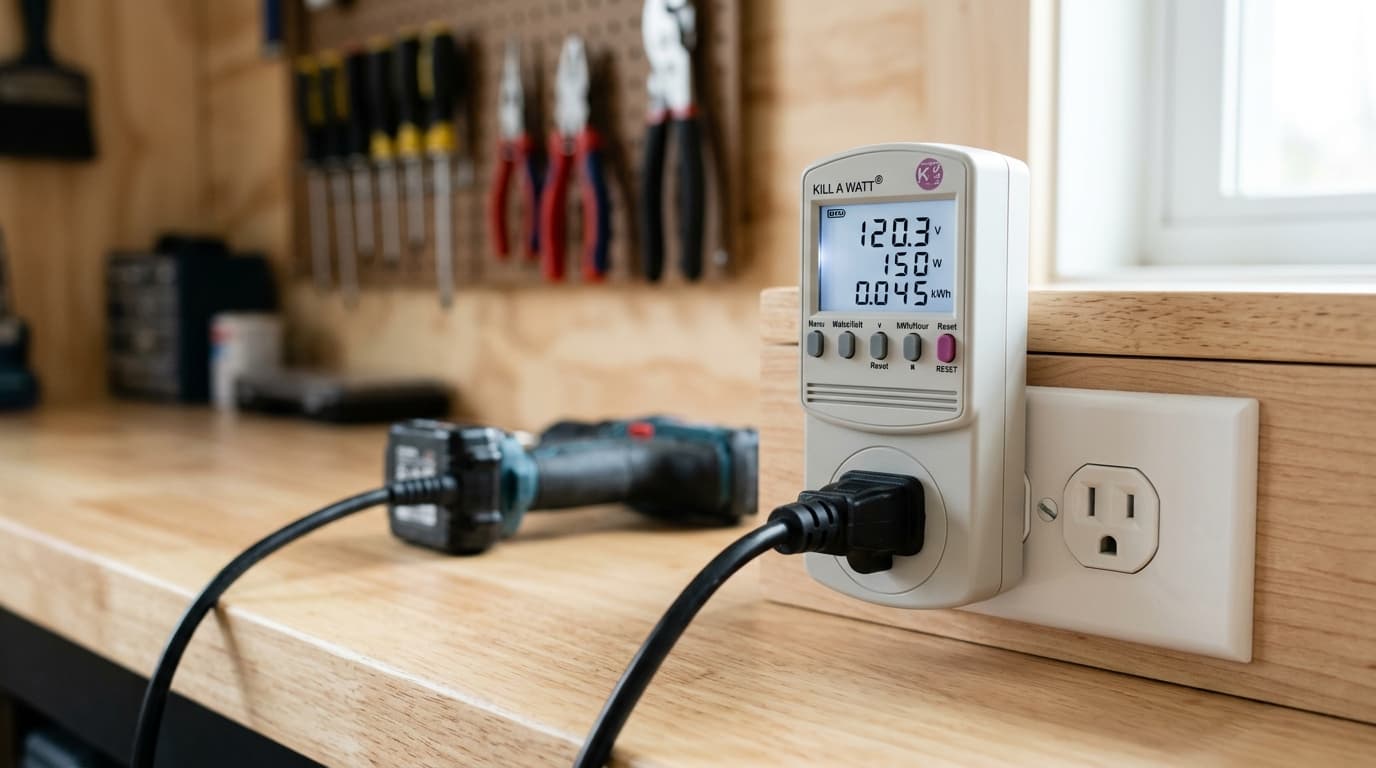
Direct Answer: What Is a Watt-Hour?
A Watt-hour (symbol: Wh) is a unit of electrical energy. It quantifies the total volume of work performed or power consumed over a given period. One Watt-hour represents exactly one Watt of power delivered continuously for one hour.
1 Watt-hour (Wh) = 1 Watt (W) × 1 Hour (h)
In terms of basic physics, one Watt equals one Joule per second. Therefore, one Watt-hour equals 1 Joule/second multiplied by 3,600 seconds, which equals exactly 3,600 Joules of physical energy.
In practical daily life:
- A 10-Watt LED light bulb left on for 10 hours consumes 100 Watt-hours (10W × 10h = 100Wh).
- A 50-Watt CPAP medical machine running for 8 hours consumes 400 Watt-hours (50W × 8h = 400Wh).
- A 100-Watt laptop charger running for 3 hours consumes 300 Watt-hours (100W × 3h = 300Wh).
- A 1,200-Watt portable microwave running for 5 minutes (0.0833 hours) consumes 100 Watt-hours (1,200W × 0.0833h = 100Wh).
Watts vs. Watt-Hours: Power vs. Energy
To master electrical planning, you must understand the distinction between power and energy:
Watts measure instantaneous power demand. When a hair dryer is set to high, it demands roughly 1,500 Watts at that exact instant. If you turn it off after 10 seconds, its power draw drops to zero immediately. Watts describe how much electrical machinery is working right now.
Watt-hours measure cumulative energy over time. Running that 1,500-Watt hair dryer for 20 minutes (one third of an hour) consumes 500 Watt-hours of energy (1,500W × 0.333h = 500Wh). Watt-hours describe the total volume of electricity drained from a battery or billed by your utility company.
Think of driving a car:
- Watts are like Miles Per Hour (Speed): They indicate how fast electricity is flowing right now.
- Watt-hours are like Miles Traveled (Distance): They indicate how much total ground you covered over time.
Driving at 60 mph for 1 hour covers 60 miles. Operating a 60-Watt light bulb for 1 hour consumes 60 Watt-hours. Driving at 60 mph for only 10 minutes covers 10 miles; running that bulb for 10 minutes consumes only 10 Watt-hours.
How to Calculate Watt-Hours (Formulas & Math)
Calculating Watt-hours requires knowing two variables: the operational wattage of your appliance and the duration it runs.
Worked Examples: Continuous Loads vs. Cycling Appliances
Real household appliances fall into two distinct operational categories:
A residential home office router, network switch, and desktop monitor draw a steady 100 Watts continuously.
A modern kitchen refrigerator draws 150 Watts when its compressor runs, but it only cycles on roughly 40% of each hour (a 40% duty cycle).
Comparing W, Wh, kW, kWh, Ah, and Volts
Electrical equipment labels combine multiple units that describe different properties of a circuit. Here is a clear summary of how these core electrical units compare:
| Unit Symbol | Category | What It Measures | Typical Real-World Example | Governing Formula |
|---|---|---|---|---|
| W (Watts) | Power | Instantaneous rate of electrical energy use | 100W incandescent lamp or laptop charger | W = V × A × PF |
| Wh (Watt-hours) | Energy | Total cumulative electricity consumed or stored | 500Wh used running a 100W load for 5 hours | Wh = W × Hours |
| kW (Kilowatts) | Power | 1,000 Watts of instantaneous demand | 1.5kW portable space heater or microwave | kW = W ÷ 1,000 |
| kWh (Kilowatt-hours) | Energy | 1,000 Watt-hours of cumulative energy | 3kWh used running a 1,500W load for 2 hours | kWh = kW × Hours |
| Ah (Amp-hours) | Electric Charge | Volume of electrical charge inside a battery | 100Ah deep-cycle marine or solar battery | Ah = A × Hours |
| V (Volts) | Potential Difference | Electrical pressure driving current flow | 120V household wall outlet or 12V battery | V = W ÷ A |
Watt-Hours vs. Kilowatt-Hours & Electric Utility Bills
In the International System of Units (SI), the prefix kilo means one thousand. Therefore:
While battery capacities and individual appliance draws are conveniently measured in Watt-hours, household electrical consumption is so large that utilities bill customers in kilowatt-hours (kWh). An average American home consumes roughly 850 to 900 kWh per month, which equals 850,000 to 900,000 Watt-hours.
Suppose you run a 1,500-Watt portable electric space heater in your bedroom for 8 hours every night:
- Calculate daily Watt-hours: 1,500W × 8h = 12,000 Wh per night.
- Convert to kilowatt-hours: 12,000 Wh ÷ 1,000 = 12 kWh per night.
- Calculate cost at an assumed rate: If your local electric utility charges an illustrative average rate of $0.16 per kWh, running that heater costs: 12 kWh × $0.16 = $1.92 per night (roughly $57.60 per month).
Watt-Hours in Batteries: Converting Amp-Hours to Watt-Hours
Batteries are frequently stamped with an Amp-hour (Ah) capacity rather than a Watt-hour rating. However, Amp-hours only tell half the story. To find the total energy stored inside any battery, you must multiply the Amp-hours by the battery nominal operating voltage:
Consider a standard 12V 100Ah deep-cycle battery:
To learn how internal cell chemistry, depth of discharge, and Peukert losses determine how many Amp-hours you can safely extract, read our dedicated technical guide on What Does Ah Mean on a Battery? Amp-Hours Explained.
How to Calculate Battery Backup Runtime
Once you know the energy capacity of your battery bank in Watt-hours and the power draw of your connected equipment in Watts, calculating basic theoretical backup duration is straightforward:
Taking our 1,200Wh battery running a 100-Watt load:
Will you actually get 12 hours of operational runtime in the real world?
No. Real-world runtime will always be lower than the theoretical formula suggests. In practice, a 12V 100Ah battery running a 100W load will deliver approximately 5.1 hours (for traditional lead-acid) to 9.2 hours (for modern LiFePO4 lithium).
Real-World Factors That Reduce Battery Runtime
When sizing an energy storage system, five physical engineering losses reduce the amount of nameplate Watt-hours you can extract:
Discharging a lead-acid or AGM battery beyond 50% causes irreversible plate sulfation and drastically shortens cycle life. That means a 1,200Wh lead-acid battery only provides 600 usable Watt-hours. In contrast, modern Lithium Iron Phosphate (LiFePO4) batteries safely sustain 80% to 90% DoD, delivering 960 to 1,080 usable Watt-hours.
Batteries store low-voltage DC power. To run 120V AC household electronics, power must flow through an inverter. High-efficiency pure sine wave inverters convert power at 85% to 92% efficiency; the remaining 8% to 15% is lost as thermal heat. Powering a 100W load at 85% inverter efficiency actually draws 117.6 Watts from the battery pack (100W ÷ 0.85 = 117.6W).
Lead-acid batteries are rated at a gentle 20-hour discharge rate. Pulling heavy current (such as running a microwave or power tool) increases internal cell resistance and cuts delivered capacity by 20% to 40%. Lithium batteries suffer almost zero Peukert losses.
Appliances with electric motors (refrigerators, sump pumps, and furnace blowers) demand momentary inrush surge wattage 2 to 4 times higher than their steady running rating when starting. While brief, frequent motor starts accelerate battery voltage sag.
Battery capacity is rated at 77°F (25°C). Operating at freezing temperatures (32°F or 0°C) reduces available lead-acid capacity by 20% to 30%, reducing delivered Watt-hours during winter weather outages.
Solar, UPS & RV Power Applications
Understanding Watt-hours allows you to properly design off-grid and backup power systems:
A 400-Watt rooftop solar array in a location with 5 peak sun hours generates roughly 2,000 Watt-hours (2 kWh) of energy per day. Sizing your battery bank to store at least 2,000Wh ensures you capture that energy without overfilling the bank.
Standard computer UPS units store between 50Wh and 150Wh in internal batteries. For extended outages, adding an external 600Wh or 1,200Wh lithium pack keeps routers and workstations running for hours instead of minutes.
Modern solar generators and power stations are explicitly sold by their Watt-hour capacity (for example, 512Wh, 1,024Wh, or 2,048Wh). This directly tells you how much total electrical work the pack can perform before needing a recharge.
Common Misconceptions to Avoid
People often say “my house used 500 Watts per hour.” This phrasing is physically meaningless. Power is already a rate (Joules per second). Dividing power by time makes no sense. The correct terminology is Watt-hours (power multiplied by time).
An inverter rated at 2,000 Watts can supply up to 2,000 Watts of instantaneous power, but it stores zero energy. Stored energy comes solely from the battery bank connected to it. A 2,000W inverter connected to an empty battery delivers zero Watt-hours.
A battery rated for 1,200Wh never yields 1,200Wh to AC appliances. Always factor in depth of discharge safety margins and 10% to 15% inverter conversion losses when sizing emergency backup systems.
Calculate Your Real-World Battery Runtime & Circuit Amps
Skip the manual calculations. Use CalcMyPower interactive tools to estimate battery runtime hours with chemistry depth of discharge and inverter efficiency, or convert circuit Watts and Amps across 12V DC, 120V AC, and 240V systems.
Frequently Asked Questions
Clear, practical answers to common questions about Watt-hours, kilowatt-hours, and electrical energy calculations.
What is a watt-hour?▾
A Watt-hour (Wh) is a unit of electrical energy measuring the total amount of work performed or electricity consumed over time. One Watt-hour equals one Watt of electrical power delivered or used continuously for one full hour (1Wh = 1W × 1 hour), which is equivalent to 3,600 Joules of physical energy.
What is the difference between watts and watt-hours?▾
Watts (W) measure instantaneous electrical power, representing the rate of energy transfer at any given moment. Watt-hours (Wh) measure cumulative electrical energy, representing the total volume of electricity consumed or stored over time. Using an automotive analogy, Watts represent speed (miles per hour), while Watt-hours represent total distance traveled (miles).
How do you calculate watt-hours?▾
To calculate Watt-hours, multiply electrical power in Watts by the duration of operation in hours: Watt-hours (Wh) = Watts (W) × Hours (h). For example, a 100-Watt appliance running continuously for 5 hours consumes 500 Watt-hours (100W × 5h = 500Wh). If an appliance cycles on and off (such as a refrigerator compressor), multiply active power draw by operating duty cycle.
How many watt-hours are in a kilowatt-hour?▾
There are exactly 1,000 Watt-hours in one kilowatt-hour (1 kWh = 1,000 Wh). Electric utility companies bill residential electricity consumption in kilowatt-hours because typical American households consume thousands of Watt-hours daily.
How do you convert Amp-hours (Ah) to Watt-hours (Wh)?▾
Multiply battery Amp-hour capacity by its nominal operating voltage: Watt-hours (Wh) = Amp-hours (Ah) × Voltage (V). For example, a 12-volt 100Ah battery stores 1,200 nominal Watt-hours (12V × 100Ah = 1,200Wh). Conversely, dividing Watt-hours by nominal voltage yields Amp-hours (Ah = Wh ÷ V).
How long will a 1,200Wh battery run a 100W device?▾
Under ideal theoretical conditions, a 1,200Wh battery would power a 100-Watt load for 12 hours (1,200Wh ÷ 100W = 12 hours). In practical applications, delivered runtime is shorter (typically 5.1 to 9.2 hours) due to chemistry depth of discharge limits (50% for lead-acid vs. 80% to 90% for lithium), DC-to-AC inverter conversion losses (8% to 15% loss as heat), and operating temperature.
What is the difference between Wh and kWh?▾
The prefix kilo represents one thousand. A Watt-hour (Wh) is the base unit of electrical energy, and a kilowatt-hour (kWh) represents 1,000 Watt-hours (1 kWh = 1,000 Wh). Small electronics, portable power stations, and individual appliance hourly usages are typically rated in Wh, while monthly residential utility bills and rooftop solar arrays are measured in kWh.
Related Power, Battery Backup & Sizing Tools
Explore companion calculators and engineering guides on CalcMyPower:
What Does Ah Mean on a Battery?
Understand battery charge capacity, chemistry depth of discharge, and Peukert discharge losses.
UPS Battery Backup Run-Time Calculator
Calculate exact runtime hours from appliance wattage, battery voltage, and Amp-hour capacity.
Watts to Amps Electrical Calculator
Convert Watts to Amps across DC circuits, 120V/240V single-phase, and 3-phase systems.
Amps to Watts Electrical Calculator
Convert circuit current in Amperes to real electrical power (Watts) and apparent power (VA).