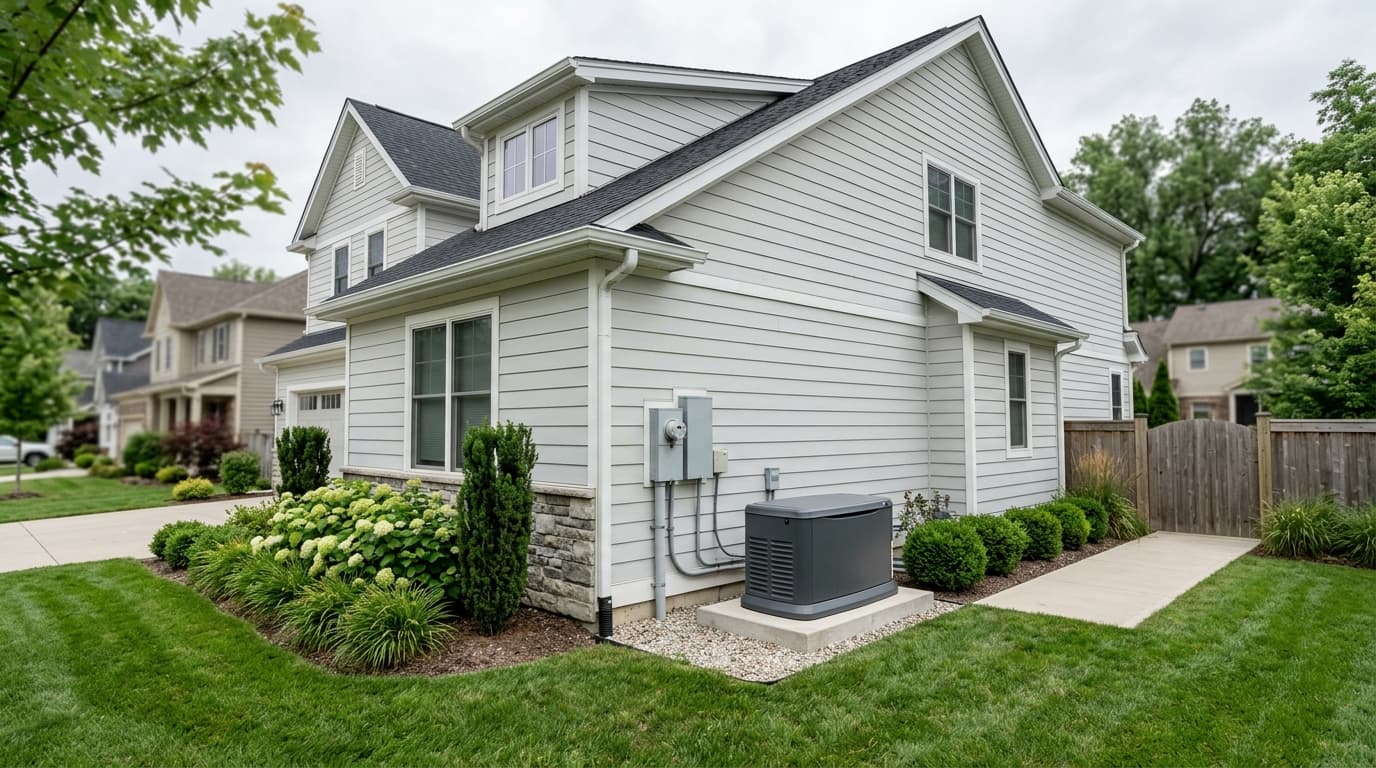
Sizing an emergency home generator comes down to an early planning decision: are you powering selected critical circuits to ride out a storm, or are you backing up the entire service panel so life continues without interruption?
For basic emergency preservation—keeping food cold in a refrigerator, powering a natural gas furnace blower for heat, running a Wi-Fi router, charging phones, and operating several LED lights—most homes require approximately 3,500 to 5,000 running Watts. If your basement relies on a 1/2 HP sump pump to prevent flooding or domestic water comes from a 240V deep-well submersible pump, planned capacity rises to 5,000 to 7,500 Watts. Sizing your electrical requirements with our interactive generator sizing tool helps pinpoint your specific household starting and running demands before purchasing equipment.
Whole-house backup that includes central air conditioning (3 to 4 tons), an electric water heater, or an electric range enters a different class altogether: either an oversized portable generator producing 9,000 to 12,000 Watts, or a permanently installed standby generator rated between 18,000 and 24,000 Watts (18–24 kW).
Typical Residential Generator Sizing Brackets
Refrigerator, gas furnace blower, internet router, phone chargers, TV, and basic room lighting.
Essentials plus a 1/2 HP sump pump, a 240V well pump, microwave oven, and an occasional small window AC.
Central air conditioning (3–5 tons), electric water heating, electric cooking, and unmanaged circuit usage.
Square footage does not dictate electrical demand. Two homes with the exact same 2,000-square-foot floor plan can have completely different power requirements depending on whether heating and cooking rely on natural gas or high-draw 240-volt electric heating elements.
How Generator Size Is Determined
A generator must deliver enough continuous wattage to sustain all active equipment, while preserving enough momentary surge capacity to start electric motors without bogging down the engine or causing voltage sag. Sizing any residential backup system hinges on four concrete variables:
- 1Continuous Running Watts:The steady-state power consumed while appliances operate normally (such as heating elements, refrigerator run cycles, and lighting).
- 2Starting (Surge) Demand:The brief burst of current (typically lasting 1 to 3 seconds) required when motor-driven compressors and pumps start from a dead stop against mechanical head pressure.
- 3Simultaneous Operation (Load Concurrency):Which appliances realistically operate at the same time. In an emergency, heating and cooling do not run simultaneously, and high-draw countertop appliances can be used one at a time. If you also plan to keep internet routers or home medical devices running during the initial minutes of an outage before a generator starts, calculate your runtime with a dedicated battery backup calculator.
- 4Electrical Connection Method:Connecting individual devices with extension cords versus feeding a dedicated 6-to-10 circuit manual transfer switch, a breaker interlock kit, or a whole-house automatic transfer switch (ATS).
Running Watts vs. Starting Watts
Every home electrical device has two distinct power metrics: running watts (rated continuous load) and starting watts (surge load).
Resistive loads—including incandescent lights, electric space heaters, toasters, and water heater elements—turn electricity directly into heat or light through simple resistance. These devices exhibit virtually zero startup surge. A 1,500-Watt space heater draws 1,500 Watts the moment it turns on and continues drawing 1,500 Watts until the thermostat clicks off. To convert individual equipment ratings between electrical units, you can use our Watts to Amps calculator to determine the exact circuit breaker current required across 120-volt or 240-volt systems.
Motor-driven inductive equipment behaves differently. Compressors in refrigerators, air conditioners, and water pumps must overcome mechanical inertia and compress refrigerants or fluids from a dead stop. During that initial 1-to-3-second startup period, the motor draws what electrical specifications define as Locked Rotor Amps (LRA). This starting inrush current can demand two to three times the appliance's steady-state running power.
| Appliance | Illustrative Running Watts | Illustrative Starting Watts | Surge Delta | Load Type |
|---|---|---|---|---|
| Refrigerator / Freezer (Energy Star) | 150 – 200 W | 1,200 W | +1,000 – 1,050 W | Inductive (Motor) |
| Sump Pump (1/2 HP, 120V) | 800 – 1,000 W | 1,800 – 2,200 W | +1,000 – 1,200 W | Inductive (Motor) |
| Submersible Well Pump (1/2 HP, 240V) | 1,000 – 1,200 W | 2,500 – 3,000 W | +1,500 – 1,800 W | Inductive (240V Motor) |
| Gas Furnace Blower Fan (1/2 HP) | 600 – 800 W | 1,600 – 2,000 W | +1,000 – 1,200 W | Inductive (Motor) |
| Central AC (3-Ton / 36,000 BTU) | 3,200 – 3,800 W | 7,500 – 9,500 W | +4,300 – 5,700 W | Heavy Inductive |
| Microwave Oven (1,000W Cooking) | 1,200 – 1,500 W | 1,200 – 1,500 W | 0 W | Resistive / Electronic |
| Home Wi-Fi Router & ONT | 20 – 35 W | 20 – 35 W | 0 W | Electronic |
| LED Home Lighting (4 Rooms) | 120 – 160 W | 120 – 160 W | 0 W | Lighting |
*Illustrative baseline values derived from U.S. Department of Energy appliance energy estimates and standard generator manufacturer engineering tables. Actual nameplate ratings vary by age, size, and motor efficiency rating.
How to Calculate Generator Size
A common sizing error is adding every appliance's starting wattage together. If you list a refrigerator (1,200W starting), a sump pump (2,000W starting), and a furnace blower (1,800W starting), naive addition suggests you need 5,000 Watts of surge capacity just for those three items.
In practice, electric motors cycle asynchronously. Your refrigerator compressor, sump pump float switch, and heating thermostat do not coordinate their startups. Adding every starting surge together assumes every motor starts at the exact same millisecond, leading to excessive oversizing and unnecessary equipment cost.
To reflect real-world operating conditions without overpaying for excess capacity, CalcMyPower uses an established four-step planning model based on our broader suite of electrical and power calculation tools:
W_running = Sum of all selected appliance running watts
Delta_W_max = Maximum of (Starting Watts - Running Watts) among active loads
W_peak = W_running + Delta_W_max
W_planning = W_peak × 1.25 (CalcMyPower Planning Headroom Factor)
The 1.25× planning headroom factor is an equipment planning margin used by CalcMyPower and recommended by generator manufacturers (such as Cummins, Generac, and Kohler). Small combustion engines run quieter, consume fuel more efficiently, and suffer less thermal stress when loaded to roughly 70% to 80% of their continuous rating.
This 25% margin is a practical equipment guideline, not a universal National Electrical Code (NEC) requirement for portable generators. While NEC Article 210.20(A) requires a 125% continuous duty rating for fixed branch circuits carrying steady loads for three hours or more, generator manufacturers apply headroom to absorb secondary startup cycles, fuel variations, and altitude losses.
Note also that this simplified model assumes only one major motor starts at a time. If an automated system re-energizes multiple large compressors simultaneously without staged delays, formal engineering load calculations are required.
Worked Example: Sizing a Generator for Essential Home Loads
Here is a realistic outage scenario for a family home backing up critical appliances through a manual transfer switch during a winter storm:
Illustrative Equipment Profile & Example Load Ratings
Representative baseline estimates for this scenario; verify actual nameplate tags on your appliances for exact values.
Translating This Calculation to Generator Nameplate Ratings
When comparing this result against manufacturer specification sheets, distinguish between the calculated planning target and the generator's physical nameplate ratings:
- Continuous Rating: Total continuous running load in this scenario is 2,955 Watts. While a 5,000-Watt rated continuous generator can carry the running load, our calculated planning capacity of 5,069 Watts (which includes the 25% planning margin above the single-motor peak) slightly exceeds 5,000 Watts. To maintain comfortable headroom and avoid loading the engine past 80%, equipment in the illustrative 5,500 to 6,500-Watt continuous class serves as a practical target for this load profile.
- Surge Capability: The generator's momentary surge rating must comfortably exceed the 4,055-Watt peak. Portable generators in this illustrative 5,500W–6,500W continuous class frequently provide around 6,800W to 8,500W of starting surge capacity depending on the manufacturer and model, easily absorbing the furnace blower's inrush demand.
- Voltage & Circuit Requirements: Because this setup feeds circuits across both panel bus bars through a home transfer switch, a dual-voltage 120V/240V connection is required (a common example on portable generators in this class is a 120/240V, 30A 4-prong locking configuration such as a NEMA L14-30 receptacle and power inlet box). The actual generator outlet, inlet box, transfer switch, wire gauge, and circuit breaker ratings must match your specific equipment and electrical installation requirements. A standard 120V-only generator cannot energize both bus bars in a split-phase panel without specialized transfer equipment.
- Fuel Type & Output Variations: If planning to run on liquid propane or natural gas instead of gasoline, verify the fuel-specific nameplate ratings. Generator output can vary by fuel type and model; multi-fuel generators typically deliver lower continuous and surge wattage on propane or natural gas than on gasoline. Check the manufacturer's specifications for exact fuel-rated capacities when selecting a unit.
What Size Generator for a 1,500, 2,000, or 2,500 Sq Ft House?
Homeowners often look for sizing rules based on home dimensions: "what size generator for 1500 sq ft house" or "what size generator for 2000 sq ft house".
Square footage gives a rough sense of house scale, but it does not determine generator size by itself. What matters is the mechanical fuel source and equipment type. Running your numbers through our home generator calculator reveals how connected wattage diverges based on appliances rather than floor space. Consider two homes of the exact same size:
- • Natural gas heating (fan only: 700W)
- • Gas water heater (control: 50W)
- • Municipal city water (no pump: 0W)
- • Gas cooktop (igniter: 50W)
Illustrative Critical Load Profile: ~3,500 to 4,500 Watts covers all essentials.
- • Electric heat pump with heat strips (8,000W+)
- • 50-gallon electric water heater (4,500W)
- • Submersible deep-well pump (1,500W run / 3,500W start)
- • Electric range and oven (3,500W)
Illustrative Critical Load Profile: ~18,000 to 22,000 Watts required for whole-home continuity.
These figures are illustrative load profiles demonstrating how equipment choice alters power demand, not universal sizing formulas. With that context in mind, here is how typical residential homes generally align across common floor plans:
Illustrative Sizing Profile for a 1,500 Sq Ft Home
In a typical 1,500 sq ft home with natural gas heating and city water, essential circuits (refrigerator, furnace fan, lights, and electronics) require roughly 3,500W to 5,000W of capacity. If you want to power a central air conditioner (typically 2 to 2.5 tons for this footprint), continuous load rises toward 7,500W to 9,500W. Full automatic whole-home backup for an all-electric 1,500 sq ft layout generally calls for an illustrative 14 kW to 18 kW standby unit.
Illustrative Sizing Profile for a 2,000 Sq Ft Home
For a 2,000 sq ft property with gas heat, essential circuits require an illustrative 4,500W to 6,500W. Adding a 3-ton central air conditioner raises demand to 8,500W to 10,500W. For hands-off, automatic whole-house coverage supporting electric water heating and general convenience, a 20 kW to 22 kW standby generator is standard.
Illustrative Sizing Profile for a 2,500 Sq Ft Home
A 2,500 sq ft home frequently features dual heating zones, larger central air conditioning compressors (3.5 to 4 tons), and higher simultaneous lighting density. Essential circuits require roughly 5,500W to 7,500W. Running central cooling alongside essentials demands 10,000W to 12,500W. Whole-house automatic standby coverage typically requires a 22 kW to 26 kW generator paired with an automatic transfer switch.
What Size Generator Do I Need for Common Appliances?
When sizing a generator for high-demand equipment, the figures below represent common residential baseline estimates. Because actual running and starting requirements vary by manufacturer, age, and compressor design, always check your equipment's data tag. Generator sizing also depends heavily on whether the appliance operates in isolation or alongside other household loads.
Running a Refrigerator on a GeneratorIsolated Load: ~1,200W Starting Surge
A modern residential refrigerator consumes only 150 to 200 running Watts. However, when the compressor cycles on, it demands a momentary startup surge of 1,000 to 1,500 Watts for approximately two seconds. In isolation, a small 2,000-Watt inverter generator handles a refrigerator with ease. In a home outage scenario where lights and a furnace blower are already running, factor in that 1,000W to 1,200W startup delta above the baseline load.
Running Central Air ConditioningIsolated Load: ~7,500–9,500W Starting Surge
Central air conditioning is the heaviest motor load in residential homes. A 3-ton (36,000 BTU) unit draws roughly 3,500 running Watts, but starting inrush current can demand 7,500 to 9,500 Watts. Powering a central AC alongside basic home circuits typically requires at least an 8,500W to 10,000W generator. However, installing an aftermarket compressor soft-starter (such as a Micro-Air EasyStart) reduces startup inrush by 60% to 70%, allowing a smaller 5,500W to 7,000W generator to start the AC without stalling the engine.
Running a Sump PumpIsolated Load: ~1,800–2,200W Starting Surge
A 1/3 HP sump pump draws roughly 600W running and 1,400W starting. A heavier 1/2 HP pump draws 800W to 1,000W running and surges to 1,800W to 2,200W when pumping against head pressure. Operating a sump pump alongside refrigeration and lights generally requires a generator in the 3,500W to 5,000W continuous range so that other appliances do not drop out when the pump switch engages.
Running a Submersible Well PumpIsolated Load: ~2,500–3,500W Starting Surge (240V Required)
Unlike 120-volt sump pumps, most residential submersible well pumps operate on 240 Volts. For illustrative planning, a typical 1/2 HP well pump draws roughly 1,000W running and 2,500W starting, while a 1 HP pump draws around 1,500W running and 3,500W starting. Because well pumps require 240V, standard 120V-only portable generators cannot power them directly. You must select a generator capable of 120V/240V dual-voltage output (for instance, utilizing a 240V locking outlet such as a NEMA L14-30R or equivalent matching your transfer hardware) with sufficient running and surge capacity for the pump and concurrent household loads, typically starting around 5,000 to 6,500 continuous Watts or higher. Always verify the pump motor nameplate data and consult a qualified electrician to ensure wire sizing and transfer hardware match the circuit requirements.
Portable Generator vs. Whole-House Standby Generator
Once you estimate your wattage demand, the primary equipment choice is between a portable unit and a permanently installed standby system. When planning transfer hardware or generator cord sizing, converting wattage to current with our Watts to Amps Calculator ensures you match your 30-amp or 50-amp inlet safely.
Portable Generators (3 kW – 12 kW)
- • Typical Cost: $600 – $2,500 for the unit; $800 – $1,500 for transfer switch and inlet box installation.
- • Fuel: Gasoline, 20-lb propane tanks, or dual-fuel options. Requires fresh fuel storage and regular stabilizer treatment.
- • Operation: Manual setup. Must be wheeled outdoors, fueled, plugged in, and started in storm conditions.
- • Best Suited For: Sump pumps, refrigeration, heating controls, and homeowners comfortable with manual deployment.
Whole-House Standby (14 kW – 26 kW)
- • Typical Cost: $4,000 – $7,500 for the unit; $3,000 – $6,000 for electrical wiring, gas piping, and municipal permits.
- • Fuel: Hard-plumbed to natural gas utility lines or a large 250–500 gallon propane tank. Continuous runtime without refueling.
- • Operation: Fully automatic. Senses utility outage, starts the engine, and transfers load within 10 to 20 seconds.
- • Best Suited For: Central air conditioning, medical equipment, all-electric homes, and hands-off reliability.
Common Generator Sizing Mistakes
1. Sizing Only from Square Footage
Square footage measures area, not electrical load. A small home with electric baseboard heat and an electric water heater requires far more generator capacity than a large home with natural gas infrastructure.
2. Summing Every Appliance's Starting Watts
Adding every startup surge assumes all motors start at the exact same fraction of a second. This artificially inflates your required generator capacity by thousands of watts.
3. Running at 100% Continuous Engine Load
Operating a generator continuously at its maximum nameplate continuous rating causes high engine temperatures, rapid fuel consumption, and voltage sag. Aim to operate within roughly 70% to 80% of rated capacity.
4. Overlooking 120V vs. 240V Requirements
Small inverter portables generally output only 120 Volts. If your plan includes a 240V well pump, central AC, or electric clothes dryer, you must have a dual-voltage 120V/240V generator.
5. Neglecting Elevation Derating
Atmospheric air density decreases at higher altitudes, reducing engine power output. Most small-engine and generator manufacturers provide model-specific altitude derating tables in their operator manuals (often advising a capacity reduction around 3% to 3.5% per 1,000 feet above a baseline elevation) along with carburetor jetting recommendations for high-altitude operation. Check your equipment manufacturer's manual if operating above 1,000 to 2,000 feet.
Calculate Your Custom Household Generator Size
Select your specific household appliances, customize wattages, and calculate running load, motor surge demand, and planning capacity directly in our interactive sizing tool.
Critical Generator Safety Rules
Emergency generators provide critical resilience during storms, but improper installation and operation introduce severe life-safety hazards.
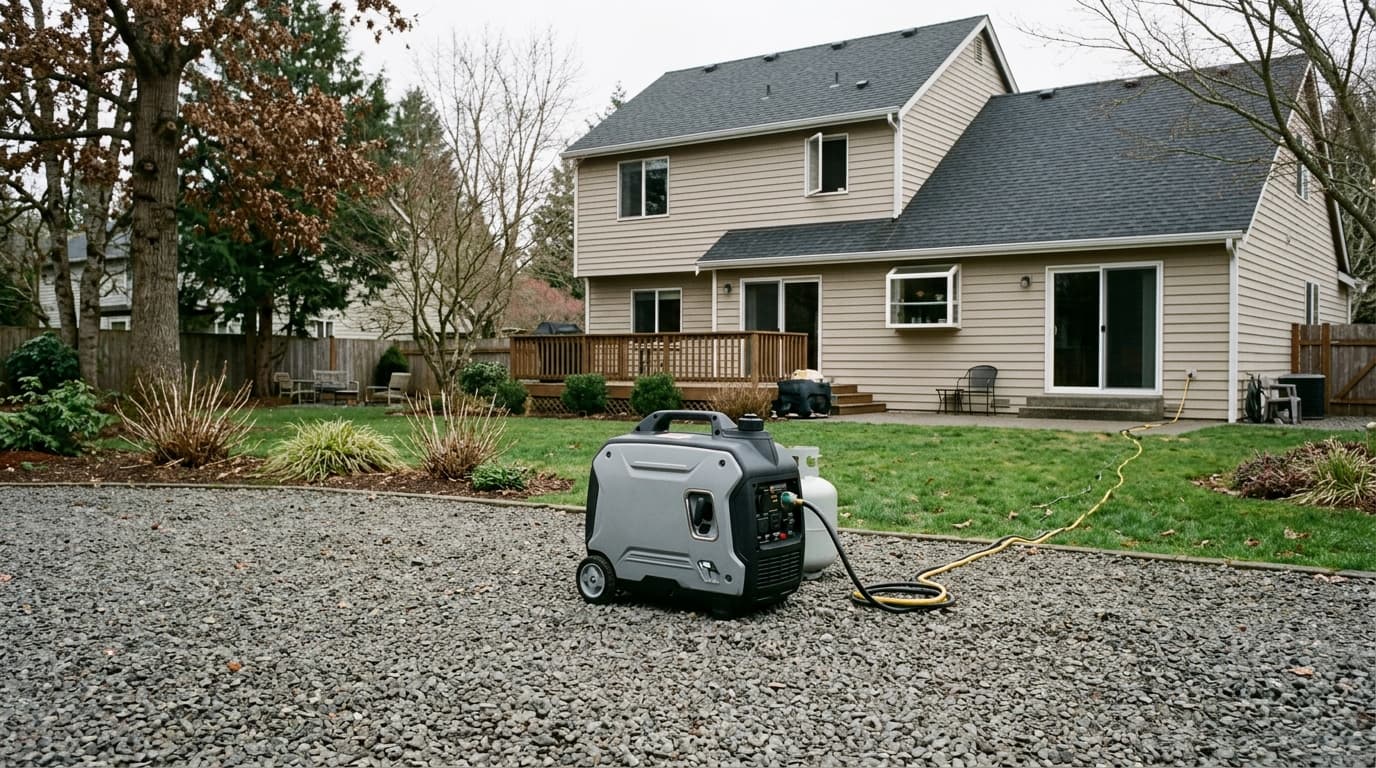
Carbon Monoxide (CO) Poisoning (CDC & CPSC Rule)
The U.S. Consumer Product Safety Commission (CPSC) and Centers for Disease Control and Prevention (CDC) issue clear guidance: portable generator exhaust produces high levels of carbon monoxide (CO)—a colorless, odorless, and lethal gas.
- Operate portable generators exclusively outdoors, at least 20 feet (6 meters) away from all windows, doors, vents, and air intakes.
- Direct the exhaust muffler away from the home and any neighboring structures.
- Never run a generator in a garage, basement, crawlspace, or covered porch, even with open doors.
- Install battery-backed carbon monoxide alarms on every living level of your home (NFPA 720).
Anti-Backfeeding & Transfer Equipment (NEC Article 702)
Never connect a generator to home wiring using a male-to-male extension cord plugged into an ordinary wall outlet. This illegal practice, known as "backfeeding," energizes the utility transformer on the street, stepping generator power up to thousands of volts on downed utility lines. This creates an immediate electrocution hazard for utility line workers and can start an electrical fire when utility power restores.
Under the National Electrical Code (NEC Article 702), connecting a generator to a building's electrical panel requires an approved manual transfer switch or a mechanical breaker interlock kit. These devices physically prevent the home from connecting to utility power and generator power at the same time. Always hire a licensed electrician to install transfer equipment.
Frequently Asked Questions
Practical answers to common residential generator sizing and selection questions.
What size generator do I need for a house?
For basic survival circuits (refrigerator, natural gas furnace blower, internet router, lights, and phones), most homes require 3,500 to 5,000 running Watts. If your home depends on a 1/2 HP sump pump or deep-well pump, plan for 5,000 to 7,500 Watts to handle motor starting inrush. Powering a 3-ton to 4-ton central air conditioner or an all-electric home requires roughly 9,000 to 12,000 Watts on a large portable generator or 18,000 to 24,000 Watts (18–24 kW) on a permanent standby generator.
Is a 5,000-watt generator enough for a house?
A generator rated for 5,000 continuous Watts can power critical essentials together: a modern refrigerator, a 1/2 HP sump pump, a gas furnace fan, LED lighting, and small electronics. However, 5,000 Watts is not enough to start central air conditioners (3 to 5 tons), an electric clothes dryer, an electric water heater, or an electric cooking range.
How many watts does a house need during a power outage?
Electrical demand depends entirely on which circuits you choose to back up. An emergency circuit profile covering refrigeration, heating controls, and communication typically draws 2,500 to 4,000 running Watts. A broader comfort setup with sump pumps, water pumps, and kitchen outlets draws 5,000 to 7,500 Watts. Full whole-home coverage with central HVAC and electric utilities generally requires 14,000 to 22,000 Watts.
Does square footage determine generator size?
No. Floor space does not draw amperes. Generator capacity is governed strictly by the specific appliances connected, their steady running power, and the starting surge of their electric motors. Two 2,000-square-foot homes can have completely different power requirements: one with natural gas heating and city water may need only 4,000 Watts, while an identical home with a 240V well pump, electric heat pump, and electric water heater can easily require 20,000 Watts.
What is the difference between running watts and starting watts?
Running watts (continuous watts) is the steady power an appliance consumes during normal operation. Starting watts (surge watts) is the momentary surge of power—often 2 to 3 times the running watts—required for 1 to 3 seconds by motor-driven equipment (refrigerators, pumps, air conditioners) to break mechanical inertia and spin up from a stop.
What size generator do I need for a 2,000 sq ft house?
In an illustrative 2,000 sq ft home with natural gas heating and city water, a 5,500 to 7,500-watt portable generator wired through a manual transfer switch easily covers essential circuits, food preservation, and entertainment. If you need to back up a 3-ton central air conditioner, you will need at least 9,000 to 11,000 Watts (or roughly 7,500 Watts if equipped with an AC compressor soft-starter). For hands-off, automatic whole-home coverage on an all-electric 2,000 sq ft property, a 20 kW to 22 kW standby generator is typical.
Related Power & Sizing Tools
Explore companion calculators on CalcMyPower to plan electrical circuits and battery backups:
Generator Size Calculator
Tally your exact appliances, calculate single-motor surge demand, and size your generator with planning headroom.
Watts to Amps Calculator
Convert generator wattage to current draw (Amps) across 120V and 240V circuits to verify breaker and cord capacity.
UPS Runtime Calculator
Calculate battery backup runtime for electronics, routers, and CPAP machines before the generator starts.