Solar Battery Calculator
Calculate the battery bank capacity needed for your off-grid or backup solar system. Size storage in kWh and Amp-hours based on daily usage and autonomy.
These are reference presets, not universal consumption claims. Enter your exact measured appliance load for precise sizing.
Typical off-grid homes consume 5 to 20 kWh/day; small camper vans consume 1 to 2.5 kWh/day.
Days of autonomy reflects how long the battery bank can sustain your daily consumption during continuous overcast weather without solar generation.
Sizing larger energy storage systems at higher DC bus voltages can reduce operating current for a given power level. Lower current can reduce conductor sizing and voltage-drop requirements. Select a system voltage compatible with your inverter, charge controller, battery, and other equipment.
Illustrative default: adjust to your battery manufacturer's specifications.
Accounts for DC-to-AC conversion loss. High-efficiency pure sine wave inverters typically range between 85% and 93%.
Simplified planning input used solely to estimate the minimum solar array wattage needed to replenish daily consumption.
6,920 Watt-hours nominal nameplate storage
Based on 4.5 peak sun hours and an illustrative 78% balance-of-system efficiency. This is a simplified educational planning guideline only, not a guaranteed solar harvest calculation.
Energy Tier Flow: Sizing Deration Sequence
Visualizing the mathematical transition from raw daily consumption down to nominal battery-bank Amp-hours.
To calculate solar battery bank capacity, follow a sequential 4-step derating methodology:
- Daily Consumption (Wh): Sum the wattage and runtime of all connected loads.
- Autonomy Multiplier: Multiply by days of autonomy (e.g. 1 to 3 reserve days).
- Inverter Derating: Divide by inverter efficiency (e.g. 85%) for conversion losses.
- Usable DoD Derating: Divide by usable depth of discharge (e.g. 85% LiFePO4 or 50% Lead-Acid) to find nominal capacity, then divide by DC bus voltage to establish bank Amp-hours.
Physical battery count cannot be determined from a single universal equation. The required quantity depends on total nominal energy storage (kWh) and chosen DC system voltage (12V, 24V, or 48V).
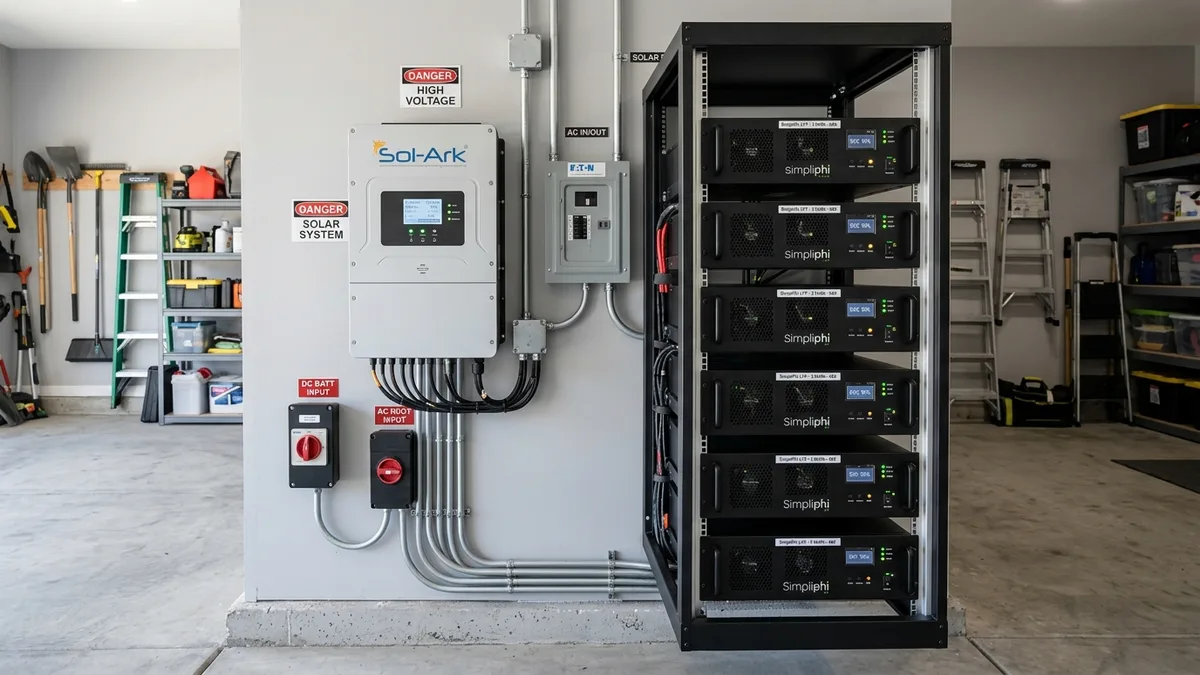
Final module quantity also depends on individual battery capacity (such as 12V 100Ah vs 48V server racks), series or parallel wiring, and manufacturer BMS current limits.
Solar Battery Sizing Formulas
The mathematical progression required to size an off-grid or emergency backup battery storage bank based on daily load, reserve autonomy, and efficiency deratings.
Variables & Constants
E_daily (Wh or kWh)N_autonomy (Days)η_inverter (Decimal (0.70 - 1.00))DoD (Decimal (0.20 - 1.00))V_dc (Volts (V))PSH (Hours/day)η_sys (Decimal (0.78 Baseline))P_pv (Watts (W))- Nominal capacity represents the total nameplate chemical energy of the battery cells.
- Usable capacity is the energy safely extracted during daily cycling without premature cell degradation.
- Higher DC bus voltages (48V) decrease operating current, reducing required wire gauge sizes and resistive thermal losses.
- Solar replenishment wattage uses a disclosed 78% balance-of-system planning baseline to account for temperature derating, wiring resistance, and dust/soiling.
Step-by-Step Worked Example: Off-Grid Cabin (4,000 Wh/day, 2 Days Autonomy)
Convert daily kilowatt-hours into base Watt-hours for uniform precision across electrical derating steps.
Multiply daily electrical consumption by desired days of autonomy (reserve capacity required to power appliances without solar generation).
Inverters consume DC energy while generating 120V/240V AC power. The battery bank must deliver 8,888.89 Wh of DC power to yield 8,000 Wh of usable AC appliance electricity.
To preserve cell longevity, batteries should not be fully discharged to 0%. Derating by the intended usable fraction (85% for LiFePO4) establishes the required total nominal nameplate capacity.
Dividing nominal energy by the selected 24V DC bus voltage determines the minimum Amp-hour capacity of the combined battery bank.
Preliminary planning estimate for the minimum solar array wattage needed to replenish one day of energy consumption under 4.5 peak sun hours with an illustrative 78% balance-of-system efficiency.
Solar Battery Bank Sizing Assumptions & Variables
Key assumptions and parameters used in calculating solar battery storage capacity, inverter efficiency derating, and solar replenishment.
| Parameter | Model Default | Typical Field Range | Practical Impact |
|---|---|---|---|
| Battery Usable Fraction (DoD) | LiFePO4: 85% | Lead-Acid AGM: 50% | 70% to 90% (LiFePO4) | 40% to 50% (Lead-Acid) | Depth of discharge values are illustrative editable defaults. Always consult your specific battery manufacturer datasheet. Deeply discharging lead-acid batteries beyond 50% causes accelerated plate sulfation, while operating LiFePO4 within 80% to 90% DoD optimizes cycle life. |
| Inverter Conversion Efficiency | 85% (Typical Real-World Baseline) | 80% to 94% across varying load percentages | Inverter efficiency varies dynamically depending on connected load percentage and ambient operating temperature. Higher quality pure sine wave inverters operating near their sweet spot can reach 90% to 94%, while light loads often drop efficiency to 75% to 82%. |
| DC System Bus Voltage | 48V DC Standard | 12V, 24V, or 48V DC options | Sizing larger energy storage systems at higher DC bus voltages reduces operating current for a given power level. Lower current reduces conductor sizing and voltage-drop requirements. Select a system voltage compatible with your inverter, charge controller, battery, and other equipment. |
| Balance-of-System (BOS) PV Efficiency | 78% Simplified Baseline | 70% to 85% depending on temperature and wiring | Solar replenishment figures are educational planning estimates only. Actual photovoltaic harvest depends on geographical coordinates, seasonal solar angles, module temperature coefficient losses, dust/soiling, and inverter/charge controller conversion losses. |
Solar Battery Sizing Frequently Asked Questions
How do I calculate solar battery capacity?
How many batteries do I need for a solar system?
What does days of autonomy mean in a solar battery bank?
What is the difference between nominal battery capacity and usable capacity?
Why does inverter efficiency affect battery bank sizing?
How do I choose between a 12V, 24V, and 48V DC bus voltage?
Does this calculator estimate how much solar PV is needed to recharge the battery?
Preliminary Planning & Engineering Disclaimer
- This tool provides preliminary educational planning estimates. It does not replace an engineered electrical design, structural review, or local building code requirements.
- Actual solar PV production depends on multiple dynamic real-world factors including geographical coordinates, seasonal solar angles, local weather, panel orientation and azimuth, roof pitch tilt, module temperature coefficients, shading obstructions, dust/soiling accumulation, and electrical conductor losses.
- Energy storage systems involve high DC currents and potential arc-flash hazards. Always follow manufacturer installation manuals and consult a licensed electrician or qualified solar engineering professional for physical equipment sizing, overcurrent protection, and NEC-compliant installation.
Related Electrical & Solar Calculators
Solar System Size Calculator
Calculate the solar system size in kW and approximate panel count required to power your home based on monthly kWh electricity consumption.
Battery Capacity & Sizing Calculator
Convert battery Amp-hours to Watt-hours, calculate usable energy, and size storage for specific continuous wattage loads.
Solar Charge Controller Calculator
Size MPPT and PWM charge controllers from solar array wattage, battery voltage, and verify cold-temperature Voc headroom.
Inverter Size Calculator
Calculate continuous and surge wattage, DC battery current draw, cable gauge (AWG), and fuse sizing across 12V, 24V, and 48V systems.
Solar Panel Tilt Angle Calculator
Calculate the optimal solar panel tilt angle and compass orientation for your latitude to maximize seasonal battery recharging.
Solar Battery Charging Time Guide
Calculate how long it takes to charge a battery with solar panels. Covers peak sun hours, MPPT vs PWM efficiency, and chemistry absorption stages.
How Many Amp Hours Do I Need for a Battery Bank?
Calculate required battery bank capacity from daily load watt-hours, system voltage, autonomy, and chemistry depth of discharge.
How Long Will a 100Ah Battery Last?
Practical runtime estimates for refrigerators, CPAP machines, TVs, and inverters across LiFePO4 and lead-acid batteries.
Solar Panels in Series vs Parallel Guide
Understand how series and parallel wiring configurations affect array operating voltage, current, and charge controller compatibility.
Watts to Amps Electrical Calculator
Convert real power in Watts to circuit current in Amperes across DC, 120V/240V single-phase, and three-phase circuits.
Voltage Drop Calculator
Calculate circuit voltage loss and verify wire gauge sizing for high-amperage 12V, 24V, and 48V DC battery inverter cables.
What Is a Watt-Hour (Wh)?
Learn the fundamental difference between instantaneous power (Watts) and total energy consumed or stored over time (Watt-hours).