Electricity Cost Calculator
Estimate your monthly electric utility bill and true effective cost per kilowatt-hour (kWh). Breakdown volumetric energy supply charges, fixed monthly customer fees, distribution delivery riders, and local taxes.
Load Reference Scenario
Monthly Usage & Tariff Inputs
Enter your monthly electric utility statement parameters below.
Total kilowatt-hours billed during the monthly billing cycle (from meter read difference).
Volumetric rate charged per kWh (for example, $0.1600 corresponds to 16.0 cents per kWh).
Recurring monthly basic service fee for meter infrastructure and billing. Billed even if usage is zero.
Grid maintenance, transmission capacity, energy efficiency mandates, and environmental surcharges.
Note: This tool does not maintain regional tax database lookups. Enter your local municipal fee and tax rate directly from your statement.
Fixed local municipal assessment, city franchise fee, or universal service surcharge.
Optional state or local sales tax applied as a percentage of the pre-tax bill subtotal.
Standard utility billing periods range from 28 to 33 calendar days (default 30).
Line-Item Bill Breakdown
100% of Total BillThe average U.S. residential customer consumes approximately 900 kWh per month with an average retail rate of ~16.5¢/kWh, yielding an estimated monthly bill of approximately $158.00.
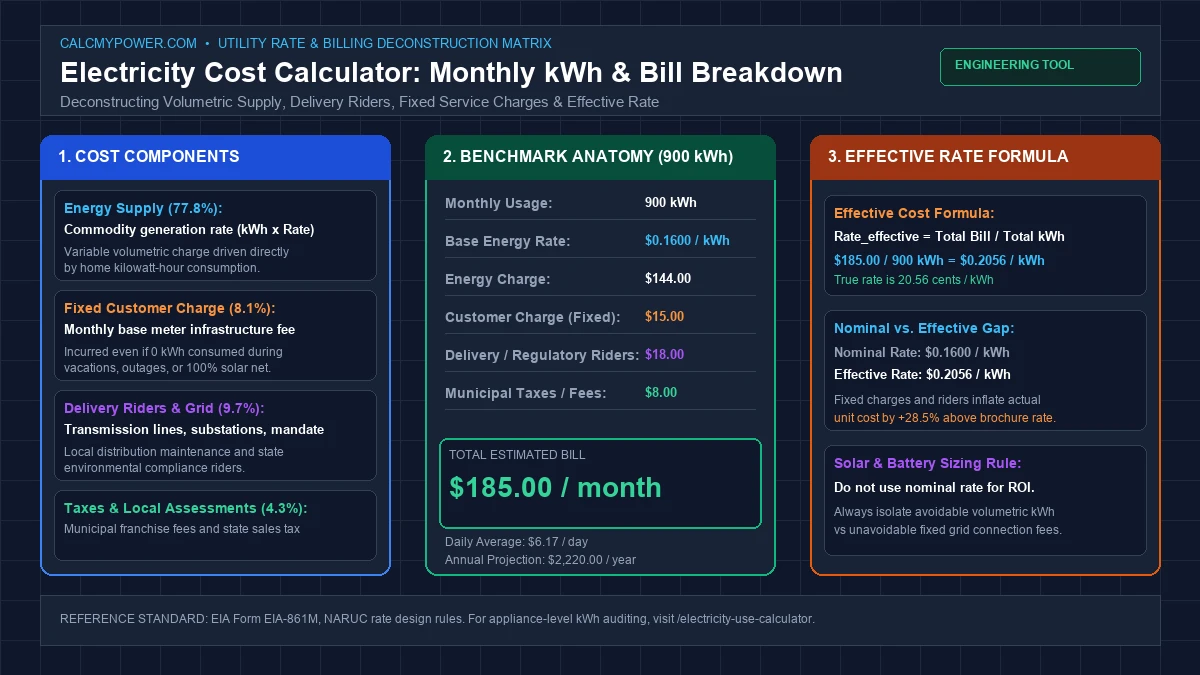
Figure 1: Deconstructing electric utility billing into volumetric supply commodity charges, fixed customer fees, distribution riders, and effective unit rates.
Need to calculate how many kWh your home uses?
If you do not know your monthly kilowatt-hour figure, use our interactive Electricity Usage Calculator to tally individual appliances, operating schedules, and duty cycles.
How to Calculate Your Electricity Bill (Full Guide)
Learn how electric utilities calculate statements from meter reads, unpack supply vs delivery tariffs, and discover why your true effective $/kWh is higher than quoted rates.
Electric utility statements vary widely based on state Public Utility Commission (PUC) rules, seasonal rate schedules (summer vs winter tiers), time-of-use hours, and local franchise agreements.
Because US utilities enforce thousands of distinct tariff formulas, this calculator does not fetch municipal tax codes. Instead, enter your statement charges directly to calculate your true effective kilowatt-hour cost.
Utility Bill Calculation Formula
Electric utility billing decomposes monthly charges into volumetric commodity supply charges, recurring customer infrastructure fees, grid maintenance riders, and government surcharges.
Variables & Constants
Billed kWh (kWh)Energy Rate ($/kWh)Fixed Charge ($/month)Riders & Surcharges ($/month)Effective Rate ($/kWh)- Nominal brochure rates exclude fixed customer fees and regulatory riders, understating your true unit electricity cost.
- Effective unit cost ($/kWh) decreases as monthly consumption rises because fixed fees are amortized over more kilowatt-hours.
- When sizing solar PV or battery backup systems, only the volumetric portion of your bill can be eliminated; fixed grid connection fees remain active under standard net metering tariffs.
Authoritative Worked Example (900 kWh U.S. Household)
Multiply total billed kilowatt-hours by the base generation energy rate.
These recurring fees cover physical poles, wires, substations, and mandated energy programs.
Sum the volumetric energy charge, fixed fees, delivery riders, and municipal taxes.
Dividing the total bill by total billed consumption reveals an effective rate +28.5% higher than the nominal $0.1600 brochure rate.
Billing Assumptions & Real-World Variables
Utility statements reflect complex tariff designs approved by state public utility commissions. Understanding these factors ensures accurate forecasting.
| Parameter | Model Default | Typical Field Range | Practical Impact |
|---|---|---|---|
| Rate Tariff Structure | Flat Volumetric ($0.16/kWh) | Flat, Tiered (Inverted Block), or Time-of-Use (TOU) | Tiered tariffs bill consumption beyond baseline thresholds at higher rates; TOU plans price peak afternoon hours higher. |
| Billing Period Length | 30 Days | 28 to 33 Calendar Days | A 33-day billing cycle naturally records higher total kWh usage than a 28-day cycle, even if daily lifestyle consumption is identical. |
| Fixed Customer Charge | $15.00 / month | $8.00 to $35.00 / month | Rural electric cooperatives and low-density utilities typically impose higher fixed charges to maintain extensive distribution lines. |
| Fuel & Power Cost Adjustments | $18.00 riders included | Fluctuates monthly based on natural gas prices | Utilities pass variable wholesale fuel prices directly to retail customers through monthly fuel cost adjustment riders. |
Utility Billing & Rate Estimation Disclaimer
- This calculator provides planning estimates based on user-supplied rate parameters and standard tariff line-item structures.
- Electric utility tariffs vary widely across U.S. service territories and are subject to regulatory approvals by state Public Utility Commissions (PUCs) or municipal governing boards.
- Actual bills may include seasonal tiered adjustments, time-of-use pricing windows, power factor penalties (for commercial accounts), and estimated meter reads.
- For exact billing disputes, tariff schedules, or net metering interconnections, consult your official utility company statement or contact your electric service provider directly.
Frequently Asked Questions: Electricity Costs & Electric Bills
Why is my effective electricity rate higher than the rate quoted by my utility?
What is the difference between supply charges and delivery charges?
How much electricity does an average American home use per month?
Will installing solar panels eliminate my entire electric bill?
How do tiered or inverted block rate tariffs work?
How can I find out how many kWh specific appliances in my house use?
Related Electrical & Solar Calculators
Electricity Usage Calculator
Calculate daily and monthly kWh consumption across household appliances with duty cycles.
Watts to Amps Calculator
Convert electrical wattage to circuit current across DC, 120V/240V single-phase, and 3-phase systems.
Amps to Watts Calculator
Convert circuit current and voltage to real electrical power (Watts) and apparent power (VA).
Solar System Size Calculator
Calculate solar panel system kW size and panel count to offset your monthly electricity bill.
Electric Utility Bill Calculation: Generation, Delivery & Tariff Riders
An electric utility statement includes generation supply rates, distribution delivery charges, fixed monthly customer connection fees, and municipal tax riders.
The Universal Electric Bill Formula
Utility bills are rarely a simple calculation of total kWh multiplied by a single quoted rate. Residential statements combine variable volumetric rates with fixed customer charges.
Supply / Generation Charge
Covers fuel costs (natural gas, nuclear, solar, hydro) to produce raw electrical energy at power generation stations. Typically accounts for 45% to 55% of the total bill.
Transmission & Delivery
Funds substation transformers, utility power poles, transmission wires, and maintenance crews that deliver current to your service panel.
Fixed Customer Charge
A flat monthly fee ($10 to $25) charged for maintaining the grid connection, meter hardware, and billing infrastructure, regardless of actual energy consumed.
Worked Example: Calculating a 900 kWh Average US Monthly Statement
According to the US Energy Information Administration (EIA), the average US home consumes approximately 900 kWh per month. Here is how a standard utility bill computes:
| Billing Line Item | Rate Basis | Unit Rate | Total Amount |
|---|---|---|---|
| Electric Generation Supply | 900 kWh | $0.085 / kWh | $76.50 |
| Distribution & Delivery | 900 kWh | $0.055 / kWh | $49.50 |
| Monthly Customer Access Fee | Fixed Monthly | Flat fee | $15.00 |
| Regulatory Surcharges & Taxes | 5% on utility charges | 5.0% | $7.05 |
| Total Monthly Electric Bill | 900 kWh Total | $0.1645 / kWh Effective | $148.05 |
Tiered Inverted-Block Rates
Under tiered rate structures, baseline consumption (e.g., initial 500 kWh) is charged at a lower rate ($0.12/kWh). Once consumption exceeds the threshold, higher tier rates ($0.22/kWh) apply to discourage excessive grid usage.
Time-of-Use (TOU) Rates
TOU tariffs vary the price per kWh by time of day. On-peak afternoon hours (4 PM to 9 PM) carry high rates, while overnight off-peak hours offer significant discounts, making battery storage and smart scheduling highly profitable.