What Size Generator Do I Need to Run a Refrigerator?
Keeping perishable food and medication cold is the first priority during a utility power outage. Sizing a generator for your refrigerator requires matching steady running watts and compressor startup surge without paying for unnecessary generator capacity.

Direct Answer: What Size Generator Runs a Refrigerator?
A generator rated for 2,000 starting watts and 1,000 running watts can comfortably start and power virtually any standard residential kitchen refrigerator. A compact 2,000 to 2,200-watt portable inverter generator is typically the sweet spot for homeowners who simply want to preserve groceries and maintain critical baseline circuits during an electrical outage.
However, no single wattage number applies universally to every home. The wattage ratings cited throughout this guide (such as 100 to 200 running watts and 800 to 1,200 starting watts) serve as representative, illustrative examples for typical modern units. Your actual requirements depend on compressor design (inverter vs. single-speed reciprocating), unit volume, internal features, ambient conditions, and what other household circuits share generator capacity. Always consult your refrigerator data plate or manufacturer specifications for exact ratings.
Practical Generator Sizing Brackets for Refrigeration
Sufficient for any modern 14 to 28 cu. ft. refrigerator running on a dedicated heavy-duty extension cord with zero high-draw heating appliances.
Powers one full-size kitchen refrigerator plus an internet router, four rooms of LED lighting, laptops, and multiple phone chargers.
Handles a primary kitchen refrigerator, a secondary garage chest or upright freezer, household lighting, and small entertainment loads safely.
Allows running your refrigerator alongside intermittent 1,000-watt microwave ovens, a 1/2 HP basement sump pump, or a gas furnace blower.
How Many Watts Does a Refrigerator Use?
When homeowners research generator requirements, they frequently encounter confusing, contradictory wattage estimates. Some sources state that a refrigerator uses 800 watts, while energy monitoring agencies report that a modern Energy Star unit draws under 150 watts. Both figures stem from real measurements, but they represent entirely different operational states.
In steady-state operation, modern residential refrigerators draw relatively little electrical power. The numbers below represent typical, illustrative examples for common U.S. residential units. Actual power requirements vary significantly by compressor technology (single-speed reciprocating versus variable-capacity inverter systems), cabinet size, ambient room temperature, and appliance age. Always verify your specific refrigerator ratings on its manufacturer data plate or owner manual:
- Compact / Mini Fridges (1.7 to 4.5 cubic feet): Typically consume 40 to 90 running watts while the compressor is actively circulating refrigerant.
- Standard Top-Freezer Models (14 to 18 cubic feet): Typically draw 90 to 150 running watts during normal cooling cycles.
- Large French-Door & Side-by-Side Units (22 to 30 cubic feet): Typically pull 140 to 220 running watts while active.
- Older Models (Built before 2005) or Commercial Units: May draw 250 to 500 running watts due to older reciprocating compressors, larger fan assemblies, and less effective cabinet thermal insulation.
Crucially, a refrigerator does not run continuously 24 hours a day. The hermetic compressor cycles on and off via an internal thermostat, operating approximately 30% to 50% of each hour under normal room temperatures. Over a full 24-hour period, a modern 25 cubic foot refrigerator consumes roughly 1.0 to 1.8 kilowatt-hours (kWh) of total electrical energy.
Why internet wattage charts vary: Many online wattage guides list nameplate full-load amperes multiplied by 120 volts. A refrigerator label stating 6.5 amps indicates the maximum current the entire appliance can draw if the compressor, defrost heating element, evaporator fan, condenser fan, and ice maker motor all operate simultaneously. During an outage, your generator only supplies the steady cooling compressor load, which is substantially lower than the maximum nameplate safety rating.
Refrigerator Running Watts vs. Starting Watts
The primary reason you cannot power a 150-watt refrigerator with a tiny 300-watt camping power station is motor inrush current, also known as starting watts or surge watts.
A refrigerator utilizes an electric motor inside its sealed compressor dome. When the internal thermostat calls for cooling, the rotor starts from a dead stop. At that initial moment, the motor draws a momentary surge of inrush current to overcome mechanical inertia and pump refrigerant vapor against static head pressure.
This startup surge typically lasts between 0.5 and 2 seconds. In general AC electric motor engineering references, stationary induction motors commonly draw momentary inrush currents several times higher than steady-state operating levels before rotor rotation establishes counter-electromotive force. In residential refrigeration, however, actual inrush varies significantly depending on compressor engineering, refrigerant type, system head pressure, and ambient temperature. Modern digital inverter compressors ramp up gradually with negligible surge, whereas older reciprocating single-speed compressors experience higher momentary peaks. It should never be assumed that a single universal multiplier applies to every refrigerator.
| Appliance Type (Illustrative Examples) | Typical Running Watts | Typical Starting Surge | Startup Characteristics |
|---|---|---|---|
| Compact / Dorm Mini Fridge | 50 W | 350 W | Compact single-speed compressor |
| Standard Top-Freezer (18 cu. ft.) | 120 W | 800 W | Standard hermetic motor assembly |
| Modern French-Door Energy Star | 160 W | 1,200 W | High-efficiency hermetic compressor |
| Standalone Chest Freezer (7 cu. ft.) | 100 W | 750 W | Low-temperature sealed compressor |
| Older Refrigerator (Pre-2005) | 250 W | 1,600 W | Older reciprocating design with high inrush |
Note: The wattages in this table are illustrative planning examples based on typical residential field measurements. Actual running and starting surge demands depend on individual model specifications, compressor head pressure at the moment of startup, and unit age. Check the manufacturer label on your specific appliance.
If your generator alternator or inverter circuitry cannot supply this surge current, the output voltage will sag dramatically. A severe voltage sag prevents the compressor rotor from spinning up, trips the generator overload protection, and can overheat the compressor motor windings.
Will a 2,000-Watt Generator Run a Refrigerator?
Yes, a 2,000-watt generator will run virtually any standard household refrigerator, provided you understand the generator continuous versus peak ratings and practice basic electrical load management.
When shopping for portable generators, remember that generators are marketed by their peak surge wattage, not their continuous output:
- A typical 2,000-watt inverter generator (such as a Honda EU2200i, Champion 2000, or Predator 2000) delivers 1,600 to 1,800 continuous running watts and 2,000 to 2,200 starting surge watts.
- A standard modern kitchen refrigerator requires approximately 160 running watts and 1,200 starting surge watts.
Because 1,200 starting watts is well below the 2,000-watt surge ceiling, the generator handles the compressor inrush without hesitation. Once running, the 160-watt load consumes less than 10% of the generator continuous capacity.
When a 2,000W Generator Works vs. When It Overloads
Refrigerator (160W run / 1,200W start) + Wi-Fi router (25W) + 5 LED bulbs (45W) + 2 phone chargers (30W) = 260W total continuous load. Even if the compressor kicks on while all devices are active, total momentary demand is 260W + 1,040W surge = 1,300W peak. This fits comfortably within the 1,600W continuous / 2,000W surge threshold.
A homeowner plugs a 1,000-watt countertop microwave into the same 2,000-watt generator. While the microwave is running, continuous draw is roughly 1,400 to 1,500 electrical watts (microwaves consume more input power than their cooking rating). If the refrigerator compressor suddenly turns on during cooking, total demand attempts to spike to 1,500W + 1,040W surge delta = 2,540W. The generator output breaker trips immediately, shutting down both appliances.
Conclusion: A 2,000-watt generator is excellent for dedicated refrigeration and communication devices. If you need to run high-draw heating appliances like coffee makers, toasters, or microwave ovens while keeping the refrigerator running, step up to a 3,500-watt generator.
What Size Generator Do I Need for a Refrigerator and Freezer?
Many American households maintain both a kitchen refrigerator-freezer combination and a dedicated standalone chest or upright freezer in a garage or basement. Sizing a generator for both cooling units is a very common requirement.
To size correctly for two cooling appliances, apply the principle of staggered compressor starting demand:
- Sum Continuous Running Power: A standard French-door refrigerator draws roughly 160 watts running, while a 10 cubic foot chest freezer draws approximately 100 watts running. Combined continuous power is only 260 running watts.
- Account for One Motor Starting Surge: Under normal operation, two independent thermostats cycle asynchronously. They will rarely start at the exact same fraction of a second. Therefore, you size for the continuous load of both units plus the starting surge delta of the single largest motor:Peak Demand = (160W + 100W) + (1,200W - 160W) = 260W + 1,040W = 1,300 Watts
- Apply Practical Planning Headroom: Step 3 establishes a baseline surge demand of 1,300 watts. In Step 4, applying CalcMyPower 25% planning headroom factor yields:CalcMyPower Planning Capacity = Baseline Surge Demand × 1.25 = 1,300W × 1.25 = 1,625 Watts
This calculation demonstrates that a quality 2,000 to 2,500-watt inverter generator provides comfortable planning capacity to support both a kitchen refrigerator and a standalone freezer.
However, if power is restored to both units simultaneously after a multi-hour outage, both compressors may attempt to start at the exact same moment because both cabinet interiors have warmed up. If both 1,200W and 750W compressors start simultaneously, peak inrush can momentarily demand nearly 2,000 watts. To avoid nuisance tripping when plugging both warm units in at once, plug in the main refrigerator first, wait 60 seconds for its compressor to stabilize, and then connect the chest freezer.
How to Check Your Refrigerator Actual Power Requirements
While general estimates are helpful for initial generator shopping, checking your refrigerator physical rating label is the most reliable way to verify its electrical specifications.
1. Locating the Electrical Rating Label
On modern residential refrigerators, the manufacturer data plate is typically located in one of four locations:
- Inside the fresh food compartment on the upper left or right side wall.
- Along the interior ceiling frame near the front LED light fixture.
- On the outer edge of the refrigerator door frame or crisper drawer track.
- On the exterior back panel near the lower compressor access grille.
2. Reading Voltage, Amperage, and Locked Rotor Amps
The label will display electrical specifications in alternating current:
- Voltage (V): In the United States, this will indicate 115V or 120V AC, 60 Hz.
- Full Load Amps (FLA) / Rated Amps (A): You will typically see a figure between 4.5A and 7.5A. As noted earlier, this represents the maximum combined draw if internal fans, electronic defrost heaters, and the compressor run simultaneously.
- Locked Rotor Amps (LRA): If listed, this indicates the absolute maximum current drawn when the compressor motor starts from a dead stop. A refrigerator showing an LRA of 11.5A on a 120V circuit requires 11.5A × 120V = 1,380 starting surge watts.
Multiplying Volts by Amps (120V × 6.0A = 720 Watts) represents apparent power in Volt-Amps (VA), which accounts for maximum design capacity rather than steady-state active watts. In alternating current circuits with inductive motor loads, actual active power (Watts) is lower than apparent power due to the motor power factor (typically 0.85 to 0.95 for modern compressors). If you need to convert nameplate current to watts precisely, use our dedicated Watts to Amps Electrical Calculator.
3. The EnergyGuide Label and Plug-In Watt Meters
If you have your appliance yellow EnergyGuide label, look at the estimated annual electricity consumption in kilowatt-hours (kWh/yr). A label rating of 500 kWh per year equates to roughly 1.37 kWh per day. Dividing 1,370 watt-hours by 24 hours reveals that the average hourly consumption is only 57 watts, accounting for both on and off compressor cycles.
To measure your refrigerator real-time active wattage before an emergency storm arrives, plug it into an inexpensive digital plug-in watt meter (such as a Kill A Watt) for 24 hours. The meter will display both the instantaneous running power and the highest peak starting surge recorded.
How to Calculate Required Generator Size
To avoid underpowering your cooling appliances or overspending on excess generator capacity, CalcMyPower utilizes a transparent, four-step load calculation model. This framework clearly separates continuous running power from momentary motor surge and continuous planning headroom:
Sum Total Continuous Running Watts
Add the steady continuous running wattage of all equipment operating at the same time:Total Running Watts = W_fridge + W_lights + W_router + W_other
Find the Largest Additional Starting Watts Delta
Determine the momentary inrush surge above running watts for the single largest electric motor:Surge Delta = Max(Starting Watts - Running Watts)
Calculate Peak Starting Demand (Baseline Surge Demand)
Combine continuous running load with the single largest motor surge delta to establish the baseline momentary surge demand:Baseline Surge Demand = Total Running Watts + Largest Surge Delta
Calculate CalcMyPower Planning Capacity (1.25× Headroom)
Multiply baseline surge demand by a 25% equipment safety buffer:CalcMyPower Planning Capacity = Baseline Surge Demand × 1.25
Planning distinction: Planning capacity is not the starting wattage rating of a single appliance. It is an overall sizing target that ensures your generator operates at approximately 75% to 80% of its continuous capability rather than redlining at maximum load. This continuous headroom maintains clean voltage regulation, prevents thermal circuit breaker trips, minimizes fuel consumption, and prolongs generator engine life.
Worked Example: Kitchen Refrigerator Outage Plan
To illustrate how this calculation works in practice, examine a realistic storm outage scenario for a suburban American household keeping food preserved while maintaining home communication.
Scenario: Emergency Food Preservation & Communication
Real-World Model- • French-Door Refrigerator (Energy Star)
- • Wi-Fi Router & Fiber Terminal
- • 4 Rooms LED Lighting (8 bulbs total)
- • 2 Smartphone Chargers & 1 Laptop
- • Refrigerator: 160W running / 1,200W starting
- • Wi-Fi & Fiber ONT: 25W running / 25W starting
- • LED Lighting: 60W running / 60W starting
- • Laptop & Phones: 80W running / 80W starting
Total Running Watts = 160W + 25W + 60W + 80W = 325 Watts
When the refrigerator compressor is running normally, all active devices together draw 325 continuous running watts.
Surge Delta = 1,200W - 160W = 1,040 Watts (Refrigerator Compressor)
The refrigerator compressor is the primary motor load with momentary startup inrush.
Baseline Surge Demand = 325W + 1,040W = 1,365 Watts
Peak starting demand reaches 1,365 watts for roughly one second when the compressor engages while other devices are active.
CalcMyPower Planning Capacity = 1,365W × 1.25 = 1,706 Watts
Applying a 25% planning margin establishes a recommended generator target of 1,706 watts planning capacity.
What Other Appliances Change the Required Generator Size?
A refrigerator alone is easy to power. What often catches homeowners off guard is how quickly additional household appliances change generator requirements.
Adding a Countertop Microwave (+1,200W)
A standard 1,000W microwave draws roughly 1,400 to 1,500 electrical watts while heating. Adding a microwave increases continuous load from 325W to 1,775W and peak demand to 2,815W.
New Minimum Generator: 3,500 WattsAdding a 1/2 HP Sump Pump (+2,100W Surge)
A 1/2 HP basement sump pump draws 800 running watts and 2,100 starting surge watts. Its 1,300W surge delta becomes the new largest motor driver.
New Minimum Generator: 4,000 to 4,500 WattsAdding a Gas Furnace Blower (+1,800W Surge)
During winter storms, heating is vital. A 1/2 HP gas furnace fan draws 600 running watts and 1,800 starting watts, requiring 120V circuit integration.
New Minimum Generator: 3,500 to 4,000 WattsAdding an Upright Deep Freezer (+750W Surge)
A standalone freezer adds only 100 to 150 running watts and 750 starting watts. As long as both compressors do not start simultaneously, demand increases modestly.
New Minimum Generator: 2,200 to 2,500 WattsTo evaluate your home complete emergency load, including water pumps, heating blowers, and air conditioners, read our comprehensive House Generator Sizing Guide.
Common Generator Sizing Mistakes for Refrigerators
1. Sizing Only for Running Watts
Purchasing a generator rated for only 300 to 500 watts because your refrigerator runs at 150 watts is the most common mistake. When the compressor cycles on, the 1,000+ watt inrush surge will instantly stall the generator or trip its overload protection.
2. Adding All Motor Starting Watts Together
Assuming that every motor starts at the exact same millisecond severely oversizes the generator. Sizing for refrigerator starting surge (1,200W) plus freezer surge (800W) plus sump pump surge (2,000W) simultaneously suggests you need a 7,000-watt generator. In reality, asynchronous cycling means only the single largest surge delta must be absorbed.
3. Using a Light Indoor Extension Cord
Plugging a refrigerator into a thin, 16 AWG 100-foot household extension cord creates severe electrical resistance. The voltage drop can reduce voltage below 105 volts at the compressor terminals, which causes the motor to stall, overheat, and fail to start.
4. Confusing Peak Surge Rating with Continuous Output
A generator advertised as 2,000 watts can only deliver 1,600 watts continuously. Sizing continuous loads up to 2,000 watts will trigger overload shutdowns within minutes once thermal breakers heat up.
Calculate Your Custom Refrigerator Outage Load
Want to calculate exact generator requirements for your specific refrigerator, freezers, and household appliances? Use CalcMyPower interactive Generator Size Calculator. You can edit running and starting wattages, add custom electronics, and export a formatted summary for an electrician.
Pre-loads the exact worked example (160W/1,200W refrigerator, Wi-Fi router, 4 rooms of LED lighting, and personal electronics) into our interactive sizing workspace.
Generator Safety: Carbon Monoxide and Safe Connections
Operating a generator during a power outage introduces serious electrical and respiratory hazards if proper safety procedures are ignored.
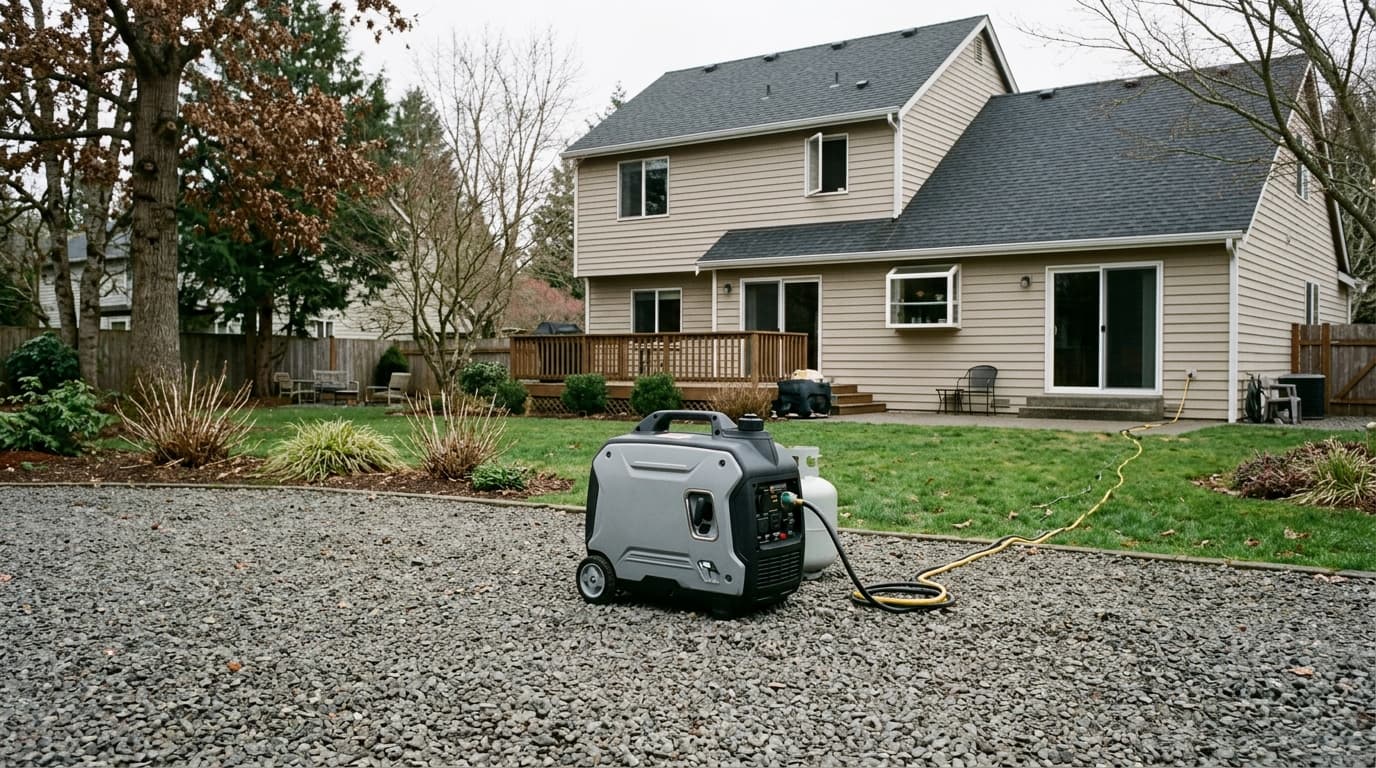
Carbon Monoxide Warning (CPSC & CDC Guidelines)
Portable generator exhaust contains high concentrations of carbon monoxide (CO), an odorless, colorless, invisible gas that can incapacitate and kill within minutes. According to the U.S. Consumer Product Safety Commission (CPSC) and the Centers for Disease Control and Prevention (CDC):
- Never operate a generator inside a home, garage, basement, crawlspace, or shed, even with doors and windows open.
- Position the generator at least 20 feet away from your home, with the engine exhaust pointing away from all windows, doors, and fresh air intake vents.
- Install battery-powered or battery-backup carbon monoxide detectors on every level of your home and outside sleeping areas.
Safe Extension Cord Selection for Refrigerators
When connecting a refrigerator to an outdoor portable generator, extension cord selection must protect both household safety and compressor motor life. In accordance with safety guidance from the Electrical Safety Foundation International (ESFI), OSHA, and appliance manufacturers, cord gauge is never determined by distance alone. Safe cord selection requires evaluating six interrelated factors:
- Actual Load Current and Starting Wattage: The cord must comfortably carry the steady continuous running amperage as well as the momentary motor inrush surge when the compressor cycles on.
- Cord Run Length: Conductor electrical resistance increases with length. Greater distances create larger voltage drops between the generator terminals and the refrigerator plug.
- Cord Continuous Amperage Rating: Never exceed the manufacturer continuous current rating printed on the cord packaging and jacket.
- Outdoor Weather Rating: Use only three-prong grounded, UL or ETL-listed cords marked with a "W" designation (such as SJTW) indicating insulation engineered for outdoor moisture and sunlight exposure.
- Manufacturer Instructions: Review both your refrigerator owner manual and generator operating manual. Some manufacturers prohibit light extension cords or require dedicated direct connections to maintain warranty coverage.
- Applicable Electrical Safety Codes: Never daisy-chain multiple extension cords together, and never route cords through windows, doors, or under rugs where physical pinching can cause insulation breakdown and fire hazards.
Illustrative examples; always verify the cord rating, connected load, length, outdoor rating, and manufacturer instructions.
To illustrate how conductor thickness must match both amperage and length together:
- A 14 AWG outdoor cord is typically rated to carry loads up to 15 amps for lengths up to 50 feet, suitable for a single modern refrigerator on a moderate run.
- For longer distances up to 100 feet, or for continuous loads up to 20 amps, step up to a heavier 12 AWG or 10 AWG cord. While a 12 AWG cord is rated for 20 amps on shorter runs, utilizing 12 AWG for a 15-amp load across 100 feet reduces electrical line resistance. Using an appropriately rated cord with the correct gauge and length helps limit voltage drop at the refrigerator.
Critical Grid Safety (Never Backfeed): Never connect a generator output cord directly into a standard household wall outlet. This dangerous practice, known as backfeeding, can energize utility lines and create a serious electrocution and fire hazard for utility lineworkers and neighbors.
Frequently Asked Questions
What size generator do I need to run a refrigerator?
A portable generator rated for at least 1,500 to 2,000 starting watts and 1,000 running watts can easily start and run virtually any single modern residential refrigerator. If you plan to power household LED lights, an internet router, and phone chargers alongside the refrigerator, a 2,000 to 2,500-watt inverter generator provides comfortable headroom. If you need to back up a kitchen refrigerator and a standalone chest freezer simultaneously, choose a generator with at least 2,200 to 3,000 surge watts.
Will a 2,000-watt generator run a refrigerator?
Yes, in almost all residential situations. A standard 2,000-watt inverter generator provides roughly 1,600 to 1,800 continuous running watts and 2,000 to 2,200 peak surge watts. Modern refrigerators require only 100 to 200 continuous running watts and brief startup surges between 800 and 1,200 watts. However, running a high-wattage heating appliance such as a 1,000-watt microwave, coffee maker, or space heater at the exact moment the refrigerator compressor kicks on can exceed the generator surge capacity and trip its circuit breaker.
How many watts does a standard refrigerator use?
A typical modern residential refrigerator uses between 100 and 200 running watts while the cooling compressor is active. Older models or large commercial merchandisers can draw 300 to 500 watts. Because refrigerator compressors cycle on and off based on interior temperature, a refrigerator only consumes power roughly 30% to 50% of the time, resulting in an average daily energy consumption of 1 to 2 kilowatt-hours (kWh).
What size generator do I need for a refrigerator and freezer?
To power a kitchen refrigerator and a standalone chest or upright freezer together, look for a generator delivering at least 2,000 to 2,500 continuous running watts and 2,500 to 3,500 starting surge watts. Combined, both units will draw only 200 to 350 steady running watts, but if both compressors ever happen to start within seconds of each other, the generator must have sufficient peak surge reserve to absorb both motor inrush spikes without stalling.
Why do refrigerators need starting watts?
Refrigerators use hermetic electric motors to drive their refrigerant compressors. When an electric motor is stationary, it lacks counter-electromotive force to limit initial current draw. Overcoming mechanical inertia and pumping dense refrigerant vapor against static head pressure creates a momentary startup inrush surge lasting 0.5 to 2 seconds before the motor reaches operational speed and settles to steady continuous running power. The surge magnitude depends on compressor design, refrigerant type, and head pressure.
Can I use an extension cord from my generator to my refrigerator?
Yes, provided the extension cord is selected based on both connected load amperage and run length in accordance with manufacturer and ESFI safety guidance. Cord gauge is never determined by distance alone. For a typical refrigerator continuous load drawing under 15 amps, a 14 AWG outdoor-rated cord is generally suitable for runs up to 50 feet. For longer distances up to 100 feet, or for heavier loads up to 20 amps, use a heavy-duty 12 AWG or 10 AWG cord. Using an appropriately rated cord with the correct gauge and length helps limit voltage drop at the refrigerator, protecting the compressor motor from overheating or failing to start.
Can I run my refrigerator on an inverter generator?
Yes, an inverter generator is ideal for refrigerators. Inverter generators produce clean electricity with low total harmonic distortion (THD under 3%), which protects the sensitive digital control boards, variable-speed fan motors, and temperature display modules found in modern Energy Star appliances while consuming less gasoline than traditional open-frame contractor generators.