Solar System Size Calculator
Calculate the solar system size and number of solar panels needed for your home. Estimate required array kW, panel count, and roof space based on electricity usage and peak sun hours.
Find total electricity kilowatt-hours from your electric utility bills. U.S. residential national average is roughly 860 to 900 kWh/month.
Target percentage of annual consumption you wish to generate with solar. 100% aims for net-zero electricity usage. Sizing above 100% plans for future EV or heat pump additions.
Peak sun hours measure solar irradiance equivalent to 1,000 W/m² (not total daylight hours). Continental U.S. values range from 3.5 to 6.0 PSH annually.
8,547 Watts DC array nameplate rating
Note: Rounding up panel count yields an installed capacity of 8.80 kW, providing a small margin above the exact baseline target.
See how physical panel count and roof footprint adjust depending on the rated wattage of the photovoltaic modules you install:
| Module Rating | Exact Ratio | Approx. Panels | Array Rating | Module Area |
|---|---|---|---|---|
| 330 Watts | 25.9 | ~26 panels | 8.58 kW | ~546 sq ft |
| 350 Watts | 24.4 | ~25 panels | 8.75 kW | ~525 sq ft |
| 375 Watts | 22.8 | ~23 panels | 8.63 kW | ~483 sq ft |
| 400 Wattsselected | 21.4 | ~22 panels | 8.80 kW | ~462 sq ft |
| 420 Watts | 20.4 | ~21 panels | 8.82 kW | ~441 sq ft |
| 450 Watts | 19.0 | ~19 panels | 8.55 kW | ~399 sq ft |
Illustrative module area calculated using approximately 21 sq ft per panel. This illustrative estimate does not model local fire setbacks, access pathways, roof obstructions, structural constraints, or jurisdiction-specific requirements.
This illustrative estimate does not model local fire setbacks, access pathways, roof obstructions, structural constraints, or jurisdiction-specific requirements.
Review our comprehensive homeowner sizing guide on solar panels in series vs parallel wiring, or see detailed daily production models in how much energy a solar panel produces.
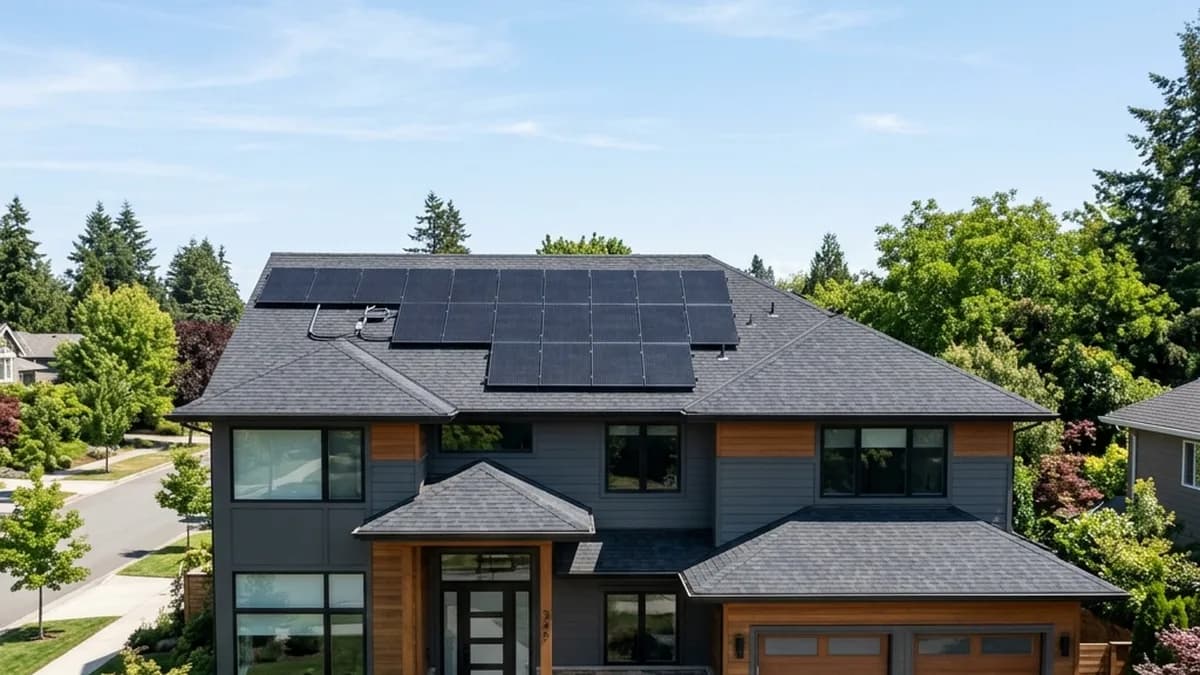
Solar Energy Sizing & Power Flow Architecture
Translating utility electricity demand into daily solar energy, DC array nameplate rating, and physical panel count.
Understanding Residential Solar System Sizing
Determining how many solar panels you need begins with analyzing annual electricity consumption rather than home square footage. Roof dimensions alone do not reflect real energy demand.
For example, two 2,500-square-foot homes can have drastically different electrical requirements. A gas-heated house might use 600 kWh monthly, while an all-electric home with heat pumps and EV charging can easily exceed 2,000 kWh per month.
A photovoltaic solar system generates electricity whenever sunlight strikes its semiconductor cells. Because energy demand fluctuates across hours, days, and seasons, grid-tied residential solar is traditionally sized to produce an amount of energy over twelve months that offsets your home's total annual kilowatt-hour demand.
How to Determine Your Daily Electricity Consumption
Electric utility companies bill customers in kilowatt-hours (kWh). One kilowatt-hour represents 1,000 Watts of electrical power consumed continuously for one hour. To find your consumption baseline:
- Gather 12 months of utility statements: Electricity consumption changes throughout the year. Winter brings electric heating loads and lighting demands, while summer drives air conditioning compressors. Summing 12 consecutive months captures seasonal peaks and valleys.
- Calculate average monthly usage: Divide your annual kilowatt-hours by 12. For example, if your home used 10,800 kWh over the past year, your average monthly consumption is 900 kWh.
- Derive daily energy demand: Dividing 900 kWh by 30 days gives a daily consumption baseline of 30.0 kWh per day.
What Are Peak Sun Hours and Why They Are Not Daylight Hours
One of the most frequent misconceptions in solar planning is confusing total daylight hours with peak sun hours (PSH). A location may experience 14 hours of daylight on a June day, yet only accumulate 5.2 peak sun hours.
Early morning and late afternoon sunlight strikes solar panels at steep angles, passing through thicker atmosphere and producing weak irradiance (often 100 to 300 W/m²). At solar noon on a clear day, irradiance approaches 1,000 W/m².
To simplify harvest calculations, solar engineers integrate fluctuating daily sunlight into equivalent hours of full 1,000 W/m² irradiance, known as peak sun hours.
According to the National Solar Radiation Database (NSRDB) maintained by the National Renewable Energy Laboratory (NREL), annualized daily peak sun hours across the United States typically range from 3.5 PSH in cloudy northern regions to 6.0+ PSH in the desert Southwest.
Understanding the Planning Performance Factor and System Losses
Solar panels carry a laboratory DC nameplate rating measured at Standard Test Conditions (STC: cell temperature of 25°C / 77°F, irradiance of 1,000 W/m², and air mass 1.5). Rooftop panels never operate permanently at STC. Several real-world factors reduce power generation:
As dark solar cells absorb sunlight on hot summer roofs, cell temperatures often reach 50°C to 65°C. Monocrystalline silicon exhibits a negative temperature coefficient of roughly -0.35% per °C above 25°C, causing an 8% to 14% drop in peak power on hot sunny days.
Solar modules generate direct current (DC), whereas household appliances and utility grids use alternating current (AC). Modern string inverters and microinverters operate at 95% to 97% peak conversion efficiency, representing a 3% to 5% loss.
Long wiring homeruns between roof solar strings, rapid-shutdown boxes, and service equipment introduce electrical resistance, consuming 1% to 2% of generated power as heat.
Pollen, dust, bird droppings, and slight factory tolerances between individual modules contribute an additional 2% to 4% in balance-of-system losses.
Combining these derating factors produces an overall Planning Performance Factor. CalcMyPower uses 78% as an illustrative planning performance factor for this simplified estimate. Actual PV system performance varies with solar resource, tilt, azimuth, shading, soiling, temperature, wiring, inverter behavior, and other site-specific conditions.
Panel Wattage: Balancing Module Count and Available Roof Area
Because solar array capacity is calculated in total kilowatts, panel wattage determines the physical module count required. Standard modern residential modules feature 54 full cells or 108 half-cut monocrystalline PERC or TOPCon cells, delivering between 390 Watts and 430 Watts within a standardized dimension of roughly 68 inches by 44 inches (~20.8 sq ft).
If your target system size is 8.55 kW (8,550 Watts):
- Using older 350-Watt panels requires 25 panels (~525 sq ft of module space).
- Using modern 400-Watt panels requires 22 panels (~462 sq ft of module space).
- Using high-output 450-Watt panels requires 19 panels (~399 sq ft of module space).
Homes with complex roof geometries, multiple dormers, chimney shadows, or limited south-facing planes benefit substantially from higher-wattage modules because fewer physical panels are needed to hit the target production capacity.
Roof Plane Sizing and Physical Layout Considerations
Calculating that an array requires approximately 22 panels provides an illustrative module surface estimate of roughly 460 square feet. However, this illustrative estimate does not model local fire setbacks, access pathways, roof obstructions, structural constraints, or jurisdiction-specific requirements. Real-world rooftop planning involves several site-specific physical factors:
- Local setback and pathway requirements: Municipal building codes often specify access margins along ridges, hips, or valleys to accommodate emergency access and ventilation, which vary by jurisdiction and roof architecture.
- Roof pitch and azimuth: True south-facing roofs (180° azimuth) at a tilt angle approximately equal to local latitude capture maximum annual solar energy. West-facing roofs produce slightly less annual total energy but align favorably with afternoon peak utility rates.
- Structural framing capacity: Solar panels, racking rails, and mounting hardware add dead load to roof rafters or trusses. Older roofs may require structural verification or reroofing before mounting equipment.
Grid-Tied Net Metering vs Battery Storage Sizing
This calculator estimates the size of your solar generation array. In a traditional grid-tied system operating under 1:1 net energy metering (NEM), the utility grid acts as a virtual battery: excess power generated at midday flows into the grid for credits, and you draw power from the grid at night.
In areas operating under net billing tariffs (such as California NEM 3.0) or for homes seeking emergency blackout resilience, adding a dedicated battery storage system is essential. If your goal is off-grid living or overnight backup power, use our dedicated Solar Battery Sizing Calculator to determine required Amp-hour and kilowatt-hour battery bank capacities independently.
Solar System Sizing Calculation Formulas
Mathematical formulas used to determine daily solar energy target, required DC array nameplate size, approximate panel count, and spatial roof area.
Variables & Constants
E_target (kWh / day)E_daily (kWh / day)Peak Sun Hours (Hours (PSH))Factor (Unitless (0.50 - 0.95))W_panel (Watts (W))Panel Count (Modules)- Assumes a standard 30-day billing cycle divisor for converting monthly utility usage to daily energy demand.
- CalcMyPower uses 78% as an illustrative planning performance factor for this simplified estimate. Actual PV system performance varies with solar resource, tilt, azimuth, shading, soiling, temperature, wiring, inverter behavior, and other site-specific conditions.
- Panel count rounding up provides a conservative planning margin; actual string inverter configurations may require specific panel multiples (such as even string lengths).
- This model provides preliminary energy planning; it does not replace site-specific shading, azimuth, or electrical service panel busbar evaluations.
Worked Example: Sizing an Average U.S. Household Solar Array (900 kWh/mo)
According to the U.S. Energy Information Administration (EIA), average residential utility customers consume roughly 860 to 900 kWh monthly. Dividing monthly consumption by 30 days yields the baseline daily energy demand.
Aiming to offset 100% of grid consumption sets the target daily solar harvest equal to daily demand. If sizing for a 75% budget offset, target solar energy would be 22.50 kWh/day.
Combining 4.5 peak sun hours with a 78% illustrative planning performance factor accounts for real-world inverter conversion, temperature derating, wiring resistance, and soiling. Dividing target daily energy by daily yield yields the required DC nameplate capacity.
Dividing total array wattage by standard 400-Watt residential modules yields 21.37 panels. Because physical solar panels cannot be fractional, the planning estimate rounds upward to 22 panels.
An installation of 22 panels produces an 8.80 kW nameplate array with an illustrative module area of approximately 462 sq ft. This illustrative estimate does not model local fire setbacks, access pathways, roof obstructions, structural constraints, or jurisdiction-specific requirements.
Solar PV Sizing Assumptions & Variables
Core technical assumptions, solar insolation metrics, and mathematical baselines used in the solar array sizing engine.
| Parameter | Model Default | Typical Field Range | Practical Impact |
|---|---|---|---|
| Standard Billing Cycle Divisor | 30 Days per Month | 28 to 31 calendar days (365 ÷ 12 = 30.4 days) | Dividing monthly utility bill usage by 30 days provides a practical planning average for daily household energy consumption. Seasonal billing variations should be reviewed across a full 12-month utility history. |
| Peak Sun Hours (PSH) | 4.5 Hours per Day (U.S. National Average) | 3.5 to 6.0 PSH across continental United States | Peak sun hours represent cumulative daily solar radiation normalized to 1,000 W/m². Actual solar harvest varies significantly by latitude, climate, seasonality, and local cloud cover. |
| Planning Performance Factor | 78% (0.78 Planning Factor) | 72% to 85% depending on equipment, climate, and site conditions | CalcMyPower uses 78% as an illustrative planning performance factor for this simplified estimate. Actual PV system performance varies with solar resource, tilt, azimuth, shading, soiling, temperature, wiring, inverter behavior, and other site-specific conditions. |
| Solar Panel Module Area | 21.0 sq ft per 400W Module | 18 to 23 sq ft per residential module | Standard modern residential 54-cell / 108-half-cell monocrystalline panels measure approximately 68 inches by 44 inches (~20.8 sq ft). This illustrative estimate does not model local fire setbacks, access pathways, roof obstructions, structural constraints, or jurisdiction-specific requirements. |
Solar System Size Frequently Asked Questions
How many solar panels do I need to power a house?
How do you calculate solar system size?
What are peak sun hours and how do they differ from daylight hours?
How does solar panel wattage affect the number of panels needed?
How much roof space do solar panels require?
What is a solar planning performance factor or derate factor?
Why is a solar sizing calculator only an educational planning estimate?
Preliminary Planning & Engineering Disclaimer
- This solar system size calculator provides preliminary mathematical estimates based on simplified balance-of-system models and user-entered utility consumption data. It does not constitute professional engineering advice, structural roof certification, electrical design, or definitive energy generation forecasts.
- Actual solar production depends heavily on exact roof compass orientation (azimuth), roof pitch, local microclimate cloud cover, tree and chimney shading, inverter clipping thresholds, electrical panel busbar limitations (NEC Section 705.12), and utility interconnection rules.
- Working with high-voltage photovoltaic direct current and utility electrical panels involves severe risks of electrical shock, arc flash, roof falls, and fire hazards. Always consult a qualified licensed solar contractor or professional electrical engineer to verify physical equipment sizing, roof structural integrity, and local permitting compliance prior to purchasing or installing solar equipment.
Related Electrical & Solar Calculators
Solar Battery Sizing Calculator
Size off-grid and backup battery storage capacity in Amp-hours and Watt-hours based on daily energy consumption.
Solar Charge Controller Calculator
Determine MPPT and PWM controller sizing based on PV array wattage, battery bus voltage, and cold-weather open-circuit voltage.
Solar Panel Tilt Angle Calculator
Calculate the optimal solar panel tilt angle and compass orientation for your latitude to maximize seasonal solar harvest.
How Much Energy Does a Solar Panel Produce?
Understand daily, monthly, and annual solar panel generation models, 400W reference examples, and balance-of-system performance factors.
Solar Panels in Series vs Parallel Guide
Learn how series and parallel solar panel wiring affects circuit voltage, current, wire size, and line losses.
Voltage Drop Calculator
Calculate voltage drop and verify conductor wire gauge for DC solar homerun feeders and AC inverter output branch circuits.
Watts to Amps Electrical Calculator
Convert real power in Watts to circuit current in Amperes across DC, 120V/240V single-phase, and balanced three-phase systems.
Residential Solar System Sizing: Array kW Demand, Panel Count & Roof Area
Sizing a residential photovoltaic (PV) array involves translating monthly kilowatt-hour consumption into array DC kilowatt capacity based on regional peak sun hours, system derating losses, and individual module wattage.
The Universal Solar Panel Count Formula
Solar arrays generate power based on peak sun hours (hours per day when sunlight intensity averages 1,000 W/m²). For this simplified estimate, CalcMyPower uses an adjustable 78% planning performance factor to approximate combined system losses. Actual PV output varies with solar resource, tilt, azimuth, shading, soiling, temperature, wiring, and inverter behavior:
US Regional Peak Sun Hours & Panel Count for 900 kWh/Month
Array capacity and panel count required to offset the US average 900 kWh monthly electric bill using modern 400-Watt monocrystalline panels:
| US Region | Peak Sun Hours (Avg) | Required Array Size | 400W Panel Count | Estimated Roof Space |
|---|---|---|---|---|
| Northeast (NY, MA, PA) | 3.8 Hours / day | 10.1 kW | 26 Panels | ~455 sq ft |
| Midwest (IL, OH, MI) | 4.2 Hours / day | 9.2 kW | 23 Panels | ~402 sq ft |
| Southeast (FL, GA, NC) | 4.8 Hours / day | 8.0 kW | 20 Panels | ~350 sq ft |
| Southwest (AZ, NV, CA) | 5.8 Hours / day | 6.6 kW | 17 Panels | ~298 sq ft |
Roof Space & Layout Constraints
A standard 400-Watt residential solar panel measures roughly 68 inches by 40 inches, occupying about 17.5 square feet. A typical 20-panel system requires approximately 350 to 400 square feet of unshaded roof plane.
Compass Orientation & Roof Pitch
In the Northern Hemisphere, true south-facing roofs deliver maximum annual energy production. East and west-facing orientations generate 15% to 20% less annual power, which can be compensated for by adding 2 to 4 additional panels.